Wednesday, May 6, 2020

Movie Review: Swallow

Swallow **** / *****
Directed by: Carlo Mirabella-Davis.
Written by: Carlo Mirabella-Davis.
Starring: Haley Bennett (Hunter Conrad), Austin Stowell (Richie Conrad), Denis O'Hare (Erwin), Elizabeth Marvel (Katherine Conrad), David Rasche (Michael Conrad), Luna Lauren Velez (Lucy), Zabryna Guevara (Alice), Laith Nakli (Luay), Babak Tafti (Aaron), Nicole Kang (Bev), Olivia Perez (Nim), Kristi Kirk (Lillian), Alyssa Bresnahan (Jill), Maya Days (Dr. Santos), Elise Santora (Dr. Reyes), Myra Lucretia Taylor (Nurse), Kathleen Butler (Lydia).
 
Swallow is hardly the first horror film to use pregnancy as a metaphor for the everyday horror of being a woman. Pregnancy makes an easy metaphor here – you now have something growing inside you, feeding off your body, your body is no longer your own, but a vessel for something else, etc. But it is, perhaps, the first horror movie to approach the subject from quite this angle. This isn’t a horror film about a woman whose body slowly becomes not her own – but rather, a horror film about a woman whose body has never been her own, and her gradual reclamation of it. It is a fascinating, subdued, horror film – not full of body or jump scares, of monsters, ghosts or serial killers – but about the everyday horror of having your body controlled.
 
In the film, Haley Bennett stars as Hunter – the beautiful, young, submissive wife of Richie (Austin Stowell), the son of a wealthy family. Hunter comes from a poor, abusive background – we get into some of the reasons for that as the film progresses – and never had control over her life. Now, she’s the wife of a rich dude – living in a beautiful, modernist house. Her husband seems nice – as do his parents – at least as long as they are not crossed. They are rich, and used to people doing what they tell them to. They’re polite to Hunter as long as she continues to act as she should. She gets pregnant – and everyone is happy. But Hunter has a secret – and that secret is she likes to swallow things. She started with a marble, then it expands to more and more strange, even dangerous, objects. Had she not been pregnant, perhaps she could have gotten away with it for a while – but an ultrasound reveals them. Soon, her husband and her family is clamping down more and more on her, controlling her more and more.
 
There is a certain degree in which Swallow resembles the other great horror film of 2020 so far – The Invisible Man, including the fact that eventually, the submissive wife decides to leave – which reveals just how awful her rich controlling husband is. But The Invisible Man is a more traditional horror film – with a more traditional villain, with more traditional beats – but handled pretty much to perfection. Swallow is a quieter film – one that sneaks up on you, and gets under your skin. Part of that is the art direction – that beautiful house, which is also cold and sterile, the sound design, which lulls you into a sense of surreal sleep. The pink hues of the art direction evoke an earlier time. And Bennett’s wonderful, subdued performance – that gives you the sense that at first, even she doesn’t know why she’s doing what she’s doing. It all adds up to evoking a waking nightmare.
 
If I have a problem with the movie, it comes in the last act – where Hunter’s past is laid probably a little too bare, in ways I didn’t find overly convincing. I’m not sure why the person she goes to see is the one she needs to get some sort of closure from – it seems kind of backwards. Yet, the scene unto itself, with Bennett’s increasingly forceful performance, and another wonderful piece of work by character actor Dennis O’Hare sells the scene, at least in the moment.
 
And the very end of the movie works wonderfully well – it may in fact be the only ending that really makes sense. The whole movie is a metaphor for how women have their bodies controlled by the patriarchal society they inhabit. Whatever other way then could the movie end?

Movie Review: Blood Quantum

Blood Quantum *** / *****
Directed by: Jeff Barnaby.
Written by: Jeff Barnaby.
Starring: Michael Greyeyes (Traylor), Elle-Máijá Tailfeathers (Joss), Forrest Goodluck (Joseph), Kiowa Gordon (Lysol), Olivia Scriven (Charlie), Stonehorse Lone Goeman (Gisigu), Brandon Oakes (Bumper), William Belleau (Shooker), Devery Jacobs (James), Gary Farmer (Moon), Felicia Shulman (Doris), Natalie Liconti (Lilith).
 
Jeff Barnaby’s debut film – Rhymes for Young Ghouls – announced a major new voice in Indigenous filmmaking in Canada – and a refreshing. That film wasn’t afraid to take on important, weighty subject matter – it’s plot dealt directly with Residential schools – but also wrapped in up in genre trapping, making it an entertaining film instead of a lecture of straight history lesson. He attempts something similar with his long awaited for follow-up – Blood Quantum – putting an Indigenous spin on the zombie film. He doesn’t play with the genre as much as he did with his debut – but he has crafted another fascinating hybrid of a film.
 
Once again, we are on the Red Creek reserve – this time in the present day. Things are already tense for the reserve Sheriff, Traylor (Michael Greyeyes) – who has a teenage son with a pregnant, white girlfriend, a few troublemakers, an ex-wife he still has feelings for, and an aging father – who complicates things even more when he won’t stop calling about the fish he just gutted, coming back to life. Barnaby takes a little bit of time setting up his own personal zombie apocalypse film – before flashing forward six months to see how far society has fallen in that time. The twist here is that if you have Indigenous blood, you are immune from the zombies – at least as far as their bites won’t turn you into one. If a horde rips your guts out though, that’s another matter.
 
The film does get bloody and violent – and the body count ratchets up more and more as the film moves along, and the kills, while not being particularly inventive for the genre, do get very bloody – and Barnaby isn’t afraid to sit there for a while as the zombies rip you apart. You are stuck watching as it happens. On the scale of a typical zombie movie, I’d say that Barnaby does a good – but not great – job. He is basically copying Romero – and everyone who has copied Romero – and while he does it very well, it’s also not overly original.
 
Where the film is original though is in its outlook. Like Romero again, Barnaby is using the zombie genre to smuggle in weighty, important themes. There are very real debates going on within the Red Creek community about survival – and what they should be doing. They are immune for the bites, but they are letting in white people as well – and protecting them, many at the insistence of Charlie, the pregnant girlfriend. But by letting them in, they are putting their own community in danger. Not letting them in basically dooms them to certain death. The film is about colonialism as much as it about anything, this time imagining a world where, for the first time in generations, the Indigenous people will actually have a say – even control – over what direction their society, and society and general, will move towards.
 
As a filmmaker, I still think Barnaby has a way to go – a way to improve. His films are heady genre films, with weighty themes, important subject matter, but also want to operate as pure genre films as well. It’s a difficult mix to pull off – and Barnaby is still trying to bring both parts together into one great film. I think he’ll get there – but it’s not quite yet.

Movie Review: Rabid (1977 and 2019)

Rabid (1977) *** ½ / *****
Directed by: David Cronenberg.
Written by: David Cronenberg.
Starring: Marilyn Chambers (Rose), Frank Moore (Hart Read), Joe Silver (Murray Cypher), Howard Ryshpan (Dr. Dan Keloid), Patricia Gage (Dr. Roxanne Keloid), Susan Roman (Mindy Kent), Roger Periard (Lloyd Walsh), Lynne Deragon (Nurse Louise), Terry Schonblum (Judy Glasberg), Victor Désy (Claude LaPointe), Julie Anna (Nurse Rita), Gary McKeehan (Smooth Eddy).
 
Rabid (2019) *** / *****
Directed by: Jen Soska and Sylvia Soska.
Written by: John Serge and Jen Soska & Sylvia Soska.
Starring: Laura Vandervoort (Rose), Benjamin Hollingsworth (Brad Hart), Ted Atherton (Dr. William Burroughs), Hanneke Talbot (Chelsea), Stephen Huszar (Dominic), Mackenzie Gray (Gunter), Stephen McHattie (Dr. Keloid), Kevin Hanchard (Dr. Riley), Heidi von Palleske (Dr. Elliot), Joel Labelle (Trent Taylor), C.M. Punk (Billy), Edie Inksetter (Dr. Beverly), Tristan Risk (Nurse Dana / Cynthia Creature), Sylvia Soska (Bev), Jen Soska (Ellie).
 
David Cronenberg’s second film, Rabid, is not one of his best. Like many of his pre-Videodrome (1983) films, it is Cronenberg still working through how to connect all his different obsessions – weird sex, body horror, psychology, identity, all into a genre film and the results are mixed. I don’t think it’s quite as good as his debut – Shivers (1975) and certainly isn’t as good as its follow-up, The Brood (1979) – but I do prefer all three to his first foray into bigger budget films – Scanners (1981). Cronenberg isn’t overly interested in his main character in Rabid – Rose, played by adult film star Marilyn Chambers. Along with her boyfriend, Hart (Frank Moore), she is involved in a motorcycle accident in the opening moments of the film, and ends up at a nearby plastic surgery clinic – and ends up having an experimental treatment done. It does work out quite as they expected – as the strange treatments have caused her to develop a new organ – a small stinger that emerges from her armpit, and can be used to suck human blood – the only thing that will keep her alive. She is patient zero in an epidemic that descends upon Montreal – martial law is declared, and Hart tries to save her – and she tries to prove she isn’t the monster she is.
 
There is room for improvement in Cronenberg’s film – which is the kind of pleasingly bizarre 1970s horror film that would likely mostly be forgotten by now had it not been an early film in the career of a master like Cronenberg – and one that so clearly shows the obsessions he would indulge for the rest of his career. The Soska sisters, Jen and Sylvia, should therefore had plenty of room to play with Cronenberg’s premise. Their remake though strangely seems to both kind of expand and contract Cronenberg’s original. They are clearly fans of Cronenberg – there are references here to many of Cronenberg’s movies, from Dead Ringers to Naked Lunch to The Fly, and probably others. Yet, the also are clearly not slaves to Cronenberg’s earlier film either – there is certainly some connective tissue here, but they have basically gone completely their own way.
 
Some of those changes work, other not so much. The biggest problem with the film is probably its first act – which basically takes 30 minutes to accomplish what Cronenberg does in 30 seconds. They clearly want their main character, Rose (Laura Vandervroot) to be a more complete character than Cronenberg’s, and they want to establish her world – she works for a fashion designer, her foster sister is a model, but poor Rose is a wallflower – which leads to one of the most ridiculous “hot girl isn’t hot because she’s wearing glasses” I have ever seen in the movie. I’m not sure I love the fashion industry stuff here – it seems too easy a target, and the film doesn’t even go as far as say The Neon Demon does – but they clearly want a more focused film than Cronenberg’s.
 
For me, that took a while to get used to – because Cronenberg’s depiction of Montreal slowly descending into chaos – the society wide outlook of that film – is really the reason to watch it. Chambers isn’t a particularly good actress – she excels in a few scenes (seducing that guy in the adult theater, writing around on the floor in pain) – but she doesn’t have much range. The Soska sister clearly just aren’t interested in that here.
 
But the remake gets better as it goes along, as it begins to focus on the changes to Rose, and the strange doctor – named Dr. William Burroughs (Ted Atherton). The climax becomes bloody, disturbing, disgusting. While the ending of this film is completely different than the ending of Cronenberg’s – they stay true to the downbeat, depressing nature of the ending.
 
Overall, it’s interesting to revisit one of Cronenberg’s earliest films. It remains interesting, but mainly for what it would setup for his future career. It’s also interesting to see the Soska’s sisters film – an early film in what hopefully will be a great career. They have the chops to make a great film – this one just isn’t it.

Movie Review: 1BR

1BR *** ½ / *****
Directed by: David Marmor.
Written by: David Marmor.
Starring: Naomi Grossman (Sarah), Giles Matthey (Brian), Andrea Gabriel (Cristina), Nicole Brydon Bloom (Sarah), Alan Blumenfeld (Gus), Taylor Nichols (Jerry), Celeste Sully (Lisa), Hailey Giles (Diane), Susan Davis (Miss Stanhope), Clayton Hoff (Lester), Jerry Ying (Officer Cho), Curtis Webster (Charles D. Ellerby), Earnestine Phillips (Ester).
 
Sarah really should be able to see something was wrong from the start. Afterall, she was able to find an apartment, in Los Angeles, that she could afford to rent without roommates, even though her only revenue is apparently a low-level job. Even if you take out the overly cheerful man who interviews her about the apartment, who asks strange questions like whether she has family in the area, or the strange guy with one eye who is always lurking, and wants you to read this book he has, or the love interest who is a little too perfect, a little too friendly, Sarah should have run far away from this apartment building.
 
It takes the first act of indie horror movie 1BR to really reveal what is going on here, but you know from the start something is wrong. And if you don’t think something is going to happen to Sarah’s cat – which she isn’t supposed to have in the apartment, then I don’t know what to do for you. It is to the films credit that despite us being ahead of the movie at first, that is able to twist and contort itself into something different – something we don’t quite see coming – even if the end of the movie calls to mind another recent indie horror film (I won’t reveal which one, since that may constitute a spoiler, but both movies end with the reveal of multiple lights of the same color).
 
Yet, 1BR is still an effective, creepy film that builds tension through the first act, ratchets it up in the second, and then gives you some cathartic, bloody relief in act three. Through it all, it’s anchored by a fine performance by Naomi Grossman, as Sarah. She is an every-millennial at the start of the movie, trying to make her way in the world, trying to get away from her family, start a job, find love, etc. And then as the mysteries of the film reveal itself – and the cult emerges – her performance becomes engagingly ambiguous. Does she become brainwashed? Is it an act? Is it a little of both?
 
Written and directed by David Marmor, 1BR is an effective little horror film. The film finds the horror in the everyday – it doesn’t rely on camera tricks, jump scares or gore for that tension. A large part of the creepiness is just how ordinary everything – and everyone – looks throughout the film. It twists little by little, to become more tense, more surreal, scarier. It is effective at each stage of its development, right up until the finale.

Movie Review: Extraction

Extraction ** ½ / *****
Directed by: Sam Hargrave.
Written by: Joe Russo base on the graphic novel by Russo.
Starring: Chris Hemsworth (Tyler Rake), Golshifteh Farahani (Nik Khan), Rudhraksh Jaiswal (Ovi Mahajan), Shivam Vichare (Sachin), Piyush Khati (Arjun), Randeep Hooda (Saju), Pankaj Tripathi (Ovi Mahajan Sr), Chris Jai Alex (Thiago), Adam Bessa (Yaz Kahn), Wayne Blair (Koen), Rayna Campbell (Ruthie), Vonzell Carter (Jose), Shataf Figar (Shadek Silver Haired Colonel), David Harbour (Gaspar), Sam Hargrave (Gaetan), Neha Mahajan (Neysa), Patrick Newall (Merc), Priyanshu Painyuli (Amir Asif), Suraj Rikame (Farhad). 
 
Chris Hemsworth is a fine actor – and an ideal action star, but it mystifies me as to why you would cast him in a role like Tyler Rake – the protagonist of Extraction. Rake has no sense of humor, really no personality whatsoever, and he basically spends the entire runtime of Extraction looking grim, and killing people. This doesn’t play to Hemsworth’s strengths – which Marvel eventually figured out including showing off his comedic side. As a humorless void of a character in Extraction, he just isn’t that interesting to watch.
 
The film was directed by Sam Hargrave, making his feature debut. He has spent most of his career as a stunt/fight coordinator, for Marvel among others, and it shows. He has basically made one long fight sequence with Extraction. This can work – the John Wick movies are basically that, as is The Raid, and they rank among the best pure action movies of the decade. But there is a fine line between the type of sustained energy that those film have, and the numbing sameness that ends up sinking Extraction. Each action scene here is basically the same – Chris Hemsworth with a gun, stalking through the streets Dhaka all in an effort to extract the son of an imprisoned drug lord, who has been kidnapped by another drug lord.
 
In movies like this, I often think of the (not very good) 1998 film Desperate Measures, that has the premise of a serial killer escaping in a hospital where he has been taken to have his bone marrow extracted to the save the life of a cop’s son. Over the course of the night many, many people get killed – but they never shoot the serial killer, because of the bone marrow, leading to the very logical question someone eventually asks “How many people need to die to save the life of one kid?”. I also found it amusing when the film pauses the action very briefly when Rake meets up with an old friend, played by David Harbour, who thinks Rake is being a hypocrite saying arguing that someone who has killed 100 people like Rake has, doesn’t get to be high and mighty. At which point, I wondered if Harbour was just talking about the last hour.
 
Which brings me to the uncomfortable heart of the movie. This kind is a white savior movie in which Hemsworth’s white guy comes in to save the Indian son. But because of that, it’s also a movie in which Hemsworth basically spends the movie killing dozens and dozens of brown people. You can kind of understand the logic that leads to this place – the Indian film industry clearly has a lot of actors and crew you can use, probably for less money than a Hollywood cast, and adding a star like Hemsworth adds to the international appeal of the film. The unintended result though cannot help but live a bad taste in your mouth.
 
As a director of action, Hargrave is pretty good. He isn’t at the level of Chad Stahelski or David Leitch – stunt coordinators turned directors of the John Wick movies, and Atomic Blonde respectively. He does try something bold – there is a 12-minute unbroken action sequence here, and it is the highlight of the film. It’s also very much like the rest of the movie though – so while I appreciate the skill and co-ordination it took to pull it off, you wish he tried something different. The reason the John Wick movies can get away with being one action sequence after the next, is because each one is different, and they keep trying to top themselves. Here, after you’ve seen one action scene, you’ve seen all the movie has to offer.

Movie Review: THe Willoughbys

The Willoughbys *** ½ / *****
Directed by: Kris Pearn.
Written by: Kris Pearn and Mark Stanleigh and Priscilla Parizeau based on the book by Lois Lowry.
Starring: Will Forte (Tim), Maya Rudolph (Nanny), Alessia Cara (Jane), Terry Crews (Commander Melanoff), Martin Short (Father), Jane Krakowski (Mother), Seán Cullen (Barnaby A & B), Ricky Gervais (The Cat), Brian Drummond (Baby Ruth /Phil /Yokel), Kris Pearn (Spoons McGee), Nancy Robertson (Irene Holmes).
 
If I were to describe the plot of the new Netflix animated film The Willoughbys, you probably think it was too dark for small children, instead of what it really is – which is an utter delight. The plot does involve neglectful, abusive parents to four children, who eventually decide that they would be better off without their parents at all, so they send them on a dangerous trip hoping to become orphans. That sounds dark, and it is, but it’s certainly in line with much children’s entertainment from Roald Dahl to J.K. Rowling to Tim Burton, and none of them have quite this candy-colored outer shell to it. The film is an episodic fantasy or escape and chosen families – and a light one at that – it floats above its premise, acknowledging the darkness, without giving in to it.
 
There are four Willoughby children – the oldest is Tim, who is obsessed with the long, proud, mustachioed history of his family – that is until his parents came along – and messed that all up. The parents (Martin Short and Jane Krakowski) love each other – but are disdainful of their children, and Tim ends up in the coal bin (which is really the dirty basement of the massive, gothic Willoughby home) for things like asking for food. His younger sister is Jane (Alessia Cara) – the more curious of them, and the one more likely to actively get in trouble. Then there are the young twins – both named Barnaby (Sean Cullen), who have to share everything – including their beloved sweater.
 
The movie is very episodic in its structure – first detailing the miserable lives of the Barnaby children with their parents, then moving on a plot involving a very curious baby, who they have to give away to a candy maker that would make Willy Wonka look normal (voiced by Terry Crews). Then there is the plot to get rid of their parents, then the bonding with the very nice nanny (Maya Rudolph) – and then the attempt to rescue their parents, etc. The film does lack a certain narrative momentum – it almost feels more like four episodes of a kids show glued together, rather than a cohesive whole.
 
Yet, it doesn’t really matter. The animation here is delightful. The Willoughbys hair is basically yarn, and each a distinctive, interesting hair style. Their design is delightful as well – each and every character taken to a different extreme. The visual comedy throughout is also a delight – particularly a montage of what happens to every adult who crosses the parents path on their trip.
 
Overall, The Willoughbys is a delight – a forgettable delight mostly, but a delight just the same. The message is slightly different than we normally see – not just to embrace your inner weirdness, but also about the power of chosen families, the resilience of children, and the gradual progress of learning to trust. It’s all wrapped up in a fast moving, candy colored package. It is ideal quarantine viewing for children – and their parents will likely have some fun as well.

Friday, May 1, 2020

Double Classic Movie Review: M (1931 & 1951)

M (1931)
Directed by: Fritz Lang.
Written by: Thea von Harbou and Fritz Lang.
Starring: Peter Lorre (Hans Beckert), Ellen Widmann (Frau Beckmann), Inge Landgut (Elsie Beckmann), Otto Wernicke (Inspector Karl Lohmann), Theodor Loos (Inspector Groeber), Gustaf Gründgens (Schränker), Friedrich Gnaß (Franz), Fritz Odemar (The Cheater), Paul Kemp (Pickpocket with Six Watches), Theo Lingen (Bauernfänger), Rudolf Blümner (Beckert's Defender), Georg John (Blind Panhandler), Franz Stein (Minister), Ernst Stahl-Nachbaur (Police Chief), Gerhard Bienert (Criminal Secretary), Karl Platen (Damowitz), Rosa Valetti (Bartender), Hertha von Walther (Prostitute). 
 
M (1951)
Directed by: Joseph Losey.
Written by: Norman Reilly Raine & Leo Katcher and Waldo Salt.
Starring: David Wayne (Martin W. Harrow), Howard Da Silva (Inspector Carney), Martin Gabel (Charlie Marshall), Luther Adler (Dan Langley), Steve Brodie (Police Lt. Becker), Raymond Burr (Pottsy), Glenn Anders (Riggert), Norman Lloyd (Sutro), Walter Burke (MacMahan), John Miljan (Blind Baloon Vendor), Roy Engel (Police Chief Regan), Janine Perreau (The Last Little Girl), Leonard Bremen (Lemke), Benny Burt (Jansen), Bernard Szold (Bradbury Bldg. Watchman), Robin Fletcher (Elsie Coster), Karen Morley (Mrs. Coster), Jim Backus (The Mayor), Jorja Curtright (Mrs. Stewart), Frances Karath (Little Girl in Hallway).
 
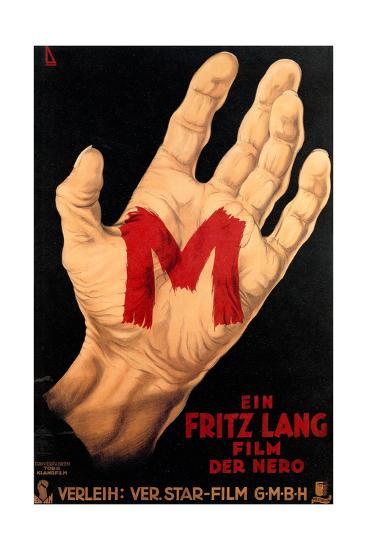
Fritz Lang’s M is one of the greatest of all films – and its influence cannot be overstated. It is one of the great early sound films – in large part because unlike many in the early years of sound, Lang didn’t go overboard with sound – he used it brilliantly but wasn’t afraid of long stretches of silence. He emphasized visuals above all – and his film is full of amazing camera work. You can see the influence – like much of German Expressionism films – on film noir, in its visuals, but also in its storytelling. It is also a film that you can trace many in the “serial killer” drama to as well – offering a complex portrait of a monster of the worst kind – a man who kills children. It is a portrait of Germany at the time Lang made it – he was only a couple years away from fleeing Germany for Hollywood at this time, the roots of Nazism was surely already there. Every time I watch it, I am truly amazed that Lang made the film he did, when he did, how he did – and it remains a masterpiece, the best film in Lang’s long, brilliant career – and one of the best films ever made.
 
Lang’s film is about a child killer who is terrorizing Berlin – as one child after another has gone missing, and the city has descended into panic. The film’s opening act is about that panic – and Lang is at his best when he can suggest so much, while showing us so little. His killer is defined by his whistle more than anything else. When we watch him take a child away – poor little Elsie Beckmann, he does it with ease and confidence – and we don’t see a whole lot. When poor Elsie is dead, Lang shows us that with a few quick shots – the balloon she was holding lost in a mess of wires, the ball she was bouncing rolling away and being left. We are shown nothing but know everything. Lang is able to show us the mounting sense of paranoia in the city – both on the streets, and in homes. The police, who have no idea how to stop this criminal, decide instead to try and stop all the other criminals – they crack down on all the underworld enterprises going on. To make matter worse for the criminals, others are staying away anyway – scared for their families. The second act is really a procedural more than anything else – but a duel one. The police are taking one track to trying, and the criminals a much different, much more brutal track. It all comes to a head at a soulless factory – that the criminals have tracked the killer to and have cornered inside.
 
Lang’s use of visuals and sound in M are a landmark for the time. It is true that many early sound films have stretches of silence in them – it was easier to do that then, and it was common. But Lang uses sound in a way that makes you think he would have done this regardless. He uses strange angles throughout the film – his camera always lurking, peering around corners, up from strange angles, stalking its characters, as if spying on them the entire time. The sound we hear if often what tells us what we need to know – but the camera is a little behind, not quite seeing, what we are hearing, which is out of frame. So, when the sound drops out, the tension mounts – and you listen closely, waiting for the next piece of sound that will tell us something.
 
M is also innovative in its depiction of its serial killer – brilliantly played in his breakthrough role by Peter Lorre, who like Lang, would flee Germany for America. We don’t quite get a good look at him – and he’s terrifying. When we finally do – when the blind beggars recognize him by his whistle, and mark him for others to follow, Lorre becomes a frightened, pathetic little man – a trapped rat. Lang does something daring – you don’t sympathize with him really, but you do empathize – it is terrifying to have all these criminals chasing you, closing in, having no where to go. Lang doesn’t explain him either – he leaves a lot of clues, but lets them dangle – leaving you to piece together what is real, and what isn’t in what he says and does – does he taunt the police with his letter, or want to be caught. Is his impassioned plea legitimate, or a last ditch effort to save his life? Lang is interested in it sure – but M ultimately is about mob mentality – something Lang returned to again and again in his career. The mob here may well have a point – that Lorre’s serial killer is evil, and needs to be stopped – but they aren’t exactly good guys either, or they take things too far. And its not like the police are corrupt or incompetent – the criminals find him first, but the cops have their own methods, and would have got to him soon. The film doesn’t even tell us the killer’s ultimate fate.
 
20 years after Lang’s M, the producer of that film, who also came to Hollywood, decided it was time to remake the film – and approached Lang to direct an American version. Lang, correctly, felt there was nothing he could better on a remake, so he passed. The job eventually fell to another great director, who would shortly after making M leave his home country – Joseph Losey. But unlike Lang when he made M, Losey was not yet at the height of his powers – he is best known for films like The Servant and Accident which he made in the 1960s – in the 1950s, Losey was a young director, still looking to establish himself. The Blacklist would drive him out of Hollywood not long after he made M – and if you can see some of Lang’s politics (that he denied were there) about his country when he made M, you can see Losey’s Communist influence on his version of M.
 
For better or for worse, Losey seems to agree with Lang that there is little he can do to improve on M – and there are whole sequences that are virtually shot for shot, word for word to Lang’s film. If there’s a difference, it’s that Losey shot on location, on the streets of Los Angeles, not a sound stage like Lang did. This does lend a rawness to Losey’s film – but he also clearly didn’t have the complete control that Lang did. David Wayne would play the killer this time – no whistling this time, but a recorder instead – making him even more of a Pied Piper character. Mostly, the two films are very similar – there is a very Freudian scene in Losey’s version – where he literally cuts the head off of a makeshift doll of a child with a picture of his mother in the background, and his plea for mercy is a little more psychological as well – but in terms of plot, it’s basically the same. Losey makes great use of the Bradbury Building – although I kind of like the soulless drabness of the building in Lang’s film. And it’s not completely fair to say Losey just copies Lang – there are interesting touches here and there, differing details that place it in America in the 1950s, not Germany in the 1930s – but for the most part, the translation is an easy one.
 
But, still, there is a reason why Lang’s film is considered a masterpiece – one of the best films ever made – and a lot of people don’t even know that Losey remade it at all. It isn’t the easiest film to find – I had to PVR it late one night off of TCM to see it after years of being curious about it. Losey’s film is good – a fine 1950s American Noir, with some nice touches and performances. But it really doesn’t come close to matching Lang’s film – with its utter strangeness, the unique angles, use of sound, strange villain, and portrait of mob rule. Lang’s film is a masterpiece – and Losey’s is a curiosity. Perhaps had Losey made it later in his career – and tried to make it his own more than he does here, it could have been – if not an equal to Lang’s film, than at least a more compelling second half of the double bill. It’s a good film – but Lang’s is one of the greatest ever made.