Showing posts with label Fritz Lang. Show all posts

Friday, May 1, 2020

Double Classic Movie Review: M (1931 & 1951)

M (1931)
Directed by: Fritz Lang.
Written by: Thea von Harbou and Fritz Lang.
Starring: Peter Lorre (Hans Beckert), Ellen Widmann (Frau Beckmann), Inge Landgut (Elsie Beckmann), Otto Wernicke (Inspector Karl Lohmann), Theodor Loos (Inspector Groeber), Gustaf Gründgens (Schränker), Friedrich Gnaß (Franz), Fritz Odemar (The Cheater), Paul Kemp (Pickpocket with Six Watches), Theo Lingen (Bauernfänger), Rudolf Blümner (Beckert's Defender), Georg John (Blind Panhandler), Franz Stein (Minister), Ernst Stahl-Nachbaur (Police Chief), Gerhard Bienert (Criminal Secretary), Karl Platen (Damowitz), Rosa Valetti (Bartender), Hertha von Walther (Prostitute). 
 
M (1951)
Directed by: Joseph Losey.
Written by: Norman Reilly Raine & Leo Katcher and Waldo Salt.
Starring: David Wayne (Martin W. Harrow), Howard Da Silva (Inspector Carney), Martin Gabel (Charlie Marshall), Luther Adler (Dan Langley), Steve Brodie (Police Lt. Becker), Raymond Burr (Pottsy), Glenn Anders (Riggert), Norman Lloyd (Sutro), Walter Burke (MacMahan), John Miljan (Blind Baloon Vendor), Roy Engel (Police Chief Regan), Janine Perreau (The Last Little Girl), Leonard Bremen (Lemke), Benny Burt (Jansen), Bernard Szold (Bradbury Bldg. Watchman), Robin Fletcher (Elsie Coster), Karen Morley (Mrs. Coster), Jim Backus (The Mayor), Jorja Curtright (Mrs. Stewart), Frances Karath (Little Girl in Hallway).
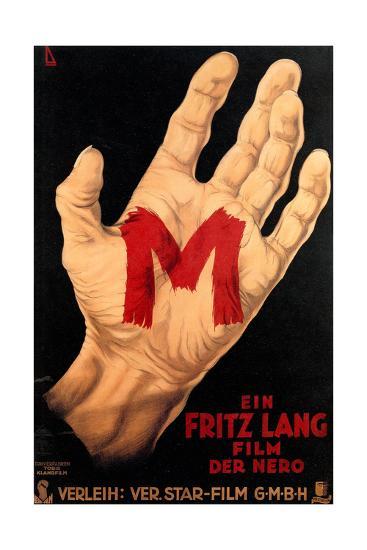
 
Fritz Lang’s M is one of the greatest of all films – and its influence cannot be overstated. It is one of the great early sound films – in large part because unlike many in the early years of sound, Lang didn’t go overboard with sound – he used it brilliantly but wasn’t afraid of long stretches of silence. He emphasized visuals above all – and his film is full of amazing camera work. You can see the influence – like much of German Expressionism films – on film noir, in its visuals, but also in its storytelling. It is also a film that you can trace many in the “serial killer” drama to as well – offering a complex portrait of a monster of the worst kind – a man who kills children. It is a portrait of Germany at the time Lang made it – he was only a couple years away from fleeing Germany for Hollywood at this time, the roots of Nazism was surely already there. Every time I watch it, I am truly amazed that Lang made the film he did, when he did, how he did – and it remains a masterpiece, the best film in Lang’s long, brilliant career – and one of the best films ever made.
 
Lang’s film is about a child killer who is terrorizing Berlin – as one child after another has gone missing, and the city has descended into panic. The film’s opening act is about that panic – and Lang is at his best when he can suggest so much, while showing us so little. His killer is defined by his whistle more than anything else. When we watch him take a child away – poor little Elsie Beckmann, he does it with ease and confidence – and we don’t see a whole lot. When poor Elsie is dead, Lang shows us that with a few quick shots – the balloon she was holding lost in a mess of wires, the ball she was bouncing rolling away and being left. We are shown nothing but know everything. Lang is able to show us the mounting sense of paranoia in the city – both on the streets, and in homes. The police, who have no idea how to stop this criminal, decide instead to try and stop all the other criminals – they crack down on all the underworld enterprises going on. To make matter worse for the criminals, others are staying away anyway – scared for their families. The second act is really a procedural more than anything else – but a duel one. The police are taking one track to trying, and the criminals a much different, much more brutal track. It all comes to a head at a soulless factory – that the criminals have tracked the killer to and have cornered inside.
 
Lang’s use of visuals and sound in M are a landmark for the time. It is true that many early sound films have stretches of silence in them – it was easier to do that then, and it was common. But Lang uses sound in a way that makes you think he would have done this regardless. He uses strange angles throughout the film – his camera always lurking, peering around corners, up from strange angles, stalking its characters, as if spying on them the entire time. The sound we hear if often what tells us what we need to know – but the camera is a little behind, not quite seeing, what we are hearing, which is out of frame. So, when the sound drops out, the tension mounts – and you listen closely, waiting for the next piece of sound that will tell us something.
 
M is also innovative in its depiction of its serial killer – brilliantly played in his breakthrough role by Peter Lorre, who like Lang, would flee Germany for America. We don’t quite get a good look at him – and he’s terrifying. When we finally do – when the blind beggars recognize him by his whistle, and mark him for others to follow, Lorre becomes a frightened, pathetic little man – a trapped rat. Lang does something daring – you don’t sympathize with him really, but you do empathize – it is terrifying to have all these criminals chasing you, closing in, having no where to go. Lang doesn’t explain him either – he leaves a lot of clues, but lets them dangle – leaving you to piece together what is real, and what isn’t in what he says and does – does he taunt the police with his letter, or want to be caught. Is his impassioned plea legitimate, or a last ditch effort to save his life? Lang is interested in it sure – but M ultimately is about mob mentality – something Lang returned to again and again in his career. The mob here may well have a point – that Lorre’s serial killer is evil, and needs to be stopped – but they aren’t exactly good guys either, or they take things too far. And its not like the police are corrupt or incompetent – the criminals find him first, but the cops have their own methods, and would have got to him soon. The film doesn’t even tell us the killer’s ultimate fate.
 
20 years after Lang’s M, the producer of that film, who also came to Hollywood, decided it was time to remake the film – and approached Lang to direct an American version. Lang, correctly, felt there was nothing he could better on a remake, so he passed. The job eventually fell to another great director, who would shortly after making M leave his home country – Joseph Losey. But unlike Lang when he made M, Losey was not yet at the height of his powers – he is best known for films like The Servant and Accident which he made in the 1960s – in the 1950s, Losey was a young director, still looking to establish himself. The Blacklist would drive him out of Hollywood not long after he made M – and if you can see some of Lang’s politics (that he denied were there) about his country when he made M, you can see Losey’s Communist influence on his version of M.
 
For better or for worse, Losey seems to agree with Lang that there is little he can do to improve on M – and there are whole sequences that are virtually shot for shot, word for word to Lang’s film. If there’s a difference, it’s that Losey shot on location, on the streets of Los Angeles, not a sound stage like Lang did. This does lend a rawness to Losey’s film – but he also clearly didn’t have the complete control that Lang did. David Wayne would play the killer this time – no whistling this time, but a recorder instead – making him even more of a Pied Piper character. Mostly, the two films are very similar – there is a very Freudian scene in Losey’s version – where he literally cuts the head off of a makeshift doll of a child with a picture of his mother in the background, and his plea for mercy is a little more psychological as well – but in terms of plot, it’s basically the same. Losey makes great use of the Bradbury Building – although I kind of like the soulless drabness of the building in Lang’s film. And it’s not completely fair to say Losey just copies Lang – there are interesting touches here and there, differing details that place it in America in the 1950s, not Germany in the 1930s – but for the most part, the translation is an easy one.
 
But, still, there is a reason why Lang’s film is considered a masterpiece – one of the best films ever made – and a lot of people don’t even know that Losey remade it at all. It isn’t the easiest film to find – I had to PVR it late one night off of TCM to see it after years of being curious about it. Losey’s film is good – a fine 1950s American Noir, with some nice touches and performances. But it really doesn’t come close to matching Lang’s film – with its utter strangeness, the unique angles, use of sound, strange villain, and portrait of mob rule. Lang’s film is a masterpiece – and Losey’s is a curiosity. Perhaps had Losey made it later in his career – and tried to make it his own more than he does here, it could have been – if not an equal to Lang’s film, than at least a more compelling second half of the double bill. It’s a good film – but Lang’s is one of the greatest ever made.

Thursday, May 23, 2019

Classic Movie Review: The Big Heat (1953)

The Big Heat (1953)
Directed by: Fritz Lang.
Written by: Sydney Boehm based on the Saturday Evening Post serial by William P. McGivern.
Starring: Glenn Ford (Dave Bannion), Gloria Grahame (Debby Marsh), Jocelyn Brando (Katie Bannion), Alexander Scourby (Mike Lagana), Lee Marvin (Vince Stone), Jeanette Nolan (Bertha Duncan), Peter Whitney (Tierney), Willis Bouchey (Lt. Ted Wilks), Robert Burton (Gus Burke), Adam Williams (Larry Gordon).
 
Fritz Lang’s The Big Heat is a cruel, merciless film noir that moves quickly throughout it 87-minute runtime and shows us a world built or corruption, violence and vengeance. Its “hero” Dave Bannion (a brilliant Glenn Ford) goes on a quest for revenge that warps him in irreparable ways – despite the sunny ending the film wraps with. But, when you think about it, Bannion was already kind of an asshole even before his (understandable) quest for revenge. Hell, if he wasn’t an asshole, if he handled things with more intelligence and tact, he wouldn’t have had reason to try to get revenge in the first place. Everything that happens in this film is basically because of him – and yet it’s the women of the film that pay the price. I suppose some would argue that the film is misogynistic – but I think the film is really showing something else – that it is women who most often pay for the behavior of men – who get to go on with their lives, get congratulated and welcomed back with a happy face. A lot of good it does for the women in The Big Heat – they’re dead.
 
The movie begins with a suicide – a high ranking cop kills himself, and leaves a note to be delivered to the D.A. – a note that could bring down the mob running things in town. The cop’s callous widow picks up the phone and calls Mike Lagana (Alexander Scourby) and tells him that she’ll keep the letter for him, which would destroy him – but it will cost him. Lagana calls up his violent henchmen – Vincent Stone (an early performance by Lee Marvin – and one of his best) to let him know the score. Stone’s girl is the delightfully ditzy Debby (Gloria Grahame, perhaps in her best performance ever) – who enjoys needling him, but also enjoys the life she has with him – enough to endure his violent outbursts. Bannion, a detective, is assigned the case – and while it looks like an open and shut suicide, things start to get more complicated when he gets a call from the dead man’s mistress. She ends up being just the first women Bannion will get killed. Bannion also has a wife and daughter – and it will be what happens to his wife (played by Jocelyn Brando, Marlon’s sister) – which will send him on the war path. And again, if he hadn’t been such an asshole, it never would have happened.
 
The film was directed by Fritz Lang, and on the surface, the film is efficient and less visually inventive than some of his earlier work – like Metropolis, M or The Testament of Dr. Mabuse. I think part of that is the budget restrictions – this is a Columbia B movie, and they operated on lesser budgets for these films – but part of it is by design. The earlier scenes are a little but more square – especially the domestic scenes in the Bannion home. It’s almost Leave it to Beaver like – the dutiful, pretty, wife who takes care of the kids, and has a steak ready for him when he comes home. The scene that really sets off Bannion on his violent rampage quite literally shakes up that domestic tranquility – the whole frame of the film shakes and upends the rest of the movie. And Lang does some other subtle tricks throughout the film as well – showing this corrupt world, but seeing it more clear eyed. Much of its insanity, and transgressiveness, is right out in the open – and treated rather matter of factly. Lagana’s “manservant” which certainly reads as gay in that scene where they are both in their pajamas. Or the rather violent posse who gathers at Bannion’s home to protect his family.
 
The film really is about toxic masculinity – and how it effects the women in these men’s lives. Bannion is so blinded by his own rage, his own self-righteousness, that he doesn’t see the damage he is doing. In many film noirs, the heroes are kind of sad sack men – guys who get sucked into a world of violence by a femme fatale, and end up doing things they would never do otherwise. They often speak in voiceovers, and their voiceovers are often sad sack whining about their lot in life. None of the men in The Big Heat are like that at all. Bannion never stops long enough to consider himself a victim. Even when, late in the film, he starts to get to know the sexy Debby, he regards her as nothing but a tool to get what he wants, never as a person – so when she shows up injured, after the film’s most famous scene involving hot coffee, he only sees how it will affect his plan. Marvin’s Vince is a little bit more pathetic – he’s kind of overgrown playground bully, who lashes out violently at those around him, but hops to when Lagana calls him up.
 
The women in The Big Heat are all victims, but they are not without agency. The all end up in a bad place, but they are not passive victims – they are attempting to change their circumstances, but are trapped by the toxic men in the film. Everyone remembers the Gloria Grahame performance of course – and they should, it is one of the performances that define her career (she had won the Supporting Actress Oscar the year before for The Bad and the Beautiful – in which she is great, but she’s better here – and she’s great for Lang in Human Desire the next year). It’s an odd performance – it’s kind of ditzy, but also rather heartfelt. She’s not really a femme fatale – although Grahame could do that – but something a little deeper. There are other fine female performances in the film – including Jocelyn Brando (Marlon’s sister) as Bannion’s wife, who looks so perfect 1950s housewife – but is made of stronger stuff than it seems.
 
The male performances are just as good though. This is an early film by Lee Marvin – and it’s interesting to see him here, before his screen persona was fully set. I’m not sure I’ve ever seen him slimier, more pathetic than he is here – and it remains one of his best performances. It is probably Glenn Ford’s best work – he could do this type of thing in his sleep, but here he digs deeper. There is more darkness to Bannion here – and he doesn’t see it, but Ford does. It is a great performance.
 
The Big Heat is one of the best film noirs – in part because Lang seems to be playing with the conventions, at least a little. None of the characters are quite what we think they are going to be, and the plot is larger scale than most – it’s not just a personal story, but something larger. It’s one of the darkest noir films I can think of – even the last scene, which on the surface is a return of normalcy, is dark when you remember that now Bannion – who we have seen do terrible things without a badge, now has his back.

Friday, February 15, 2013

The Best Movies I Have Never Seen Before: Human Desire (1954)

Human Desire (1954)
Directed by: Fritz Lang.
Written by: Alfred Hayes based on the novel by Émile Zola.
Starring: Glenn Ford (Jeff Warren), Gloria Grahame (Vicki Buckley), Broderick Crawford (Carl Buckley), Edgar Buchanan (Alec Simmons), Kathleen Case (Ellen Simmons), Peggy Maley (Jean), Diane DeLaire (Vera Simmons), Grandon Rhodes (John Owens).

Fritz Lang reteamed with Glenn Ford and Gloria Grahame a year after the trio made one of the best film noirs in history with The Big Heat, to make another great noir, Human Desire in 1954. This film’s reputation is nowhere near as great as The Big Heat, which could be due to a number of reasons. One is that the ending of Human Desire, while wholly appropriate to the story, doesn’t quite pack the same thrill as the ending of The Big Heat. Another reason could be that Jean Renoir had already adapted Emile Zola’s highly regarded novel, La Bete Humaine, in 1938, and while Human Desire is a great film, Renoir’s film is a flat out masterpiece. But for whatever reason, Human Desire has never really been counted as one of Lang’s best films – not even one of his best American noirs – and that’s a shame, because it is a great movie.

The plot involves Jeff Warren (Ford), who has just come back from the Korean War, and wants nothing more than to return to his old job as a railroad engineer, meet a nice girl and settle down. The daughter of an associate, Vera (Diane DeLaire), pretty much throws herself at Ford, but he is hesitant. It isn’t that she isn’t beautiful, or even that she is the daughter of a friend, but more because he knew her as a kid, and he hasn’t quite gotten over that yet. Besides, there is another woman who has her eyes on Jeff. This is Vicki (Gloria Grahame), but she’s already married to the violent, jealous Carl (Broderick Crawford), who works for the same railroad. The two of them meet because Jeff is hitching a ride home on a late night train, that Vicki and Carl are also taking, but for more sinister reasons. Carl has just lost his job, and needs Vicki’s contact with a rich man to get it back. But Carl is not impressed when Vicki spends too much time with the rich man – deducing that more than talk went on. They are on the train so that Carl can take his revenge on the rich man – which he does. He then sends Vicki to distract Jeff, so that he can make it back to his compartment, before anyone catches him with the body. But when Jeff’s eyes meet Vicki, he is lost, and she knows it. She thinks that perhaps she has found her way out of an abusive marriage. After all, Jeff has killed before, in the army, so why would killing Carl be so different?

Lang’s best films exist in a moral grey area. Most films of the era have things in strictly black and white terms – these are the good guys, and these are the bad guys – but in Lang’s films, they get all messed up. His best film may well be M (1931), where a child murderer (Peter Lorre) is on the loose, and the corrupt police and politicians cannot stop him, so the underground does it for them. These are criminals and murderers themselves, but even they are disgusted by a child murderer in their midst. No one is innocent, but some just simply aren’t as bad as others. The same thing is at work in Human Desire. Jeff may be on shaky moral ground for killing in war (it depends on how you see war), but he certainly crosses a line when he begins an affair with Vicki. But will his morals allow him to go a step further, and kill Carl, who after all, is a murderer and a brute himself? While Vicki fits the mold of the femme fatale, she isn’t quite as evil as someone like Barbara Stanwyck in Double Indemnity, who convinces innocent Fred MacMurray to kill her husband for her. After all, Vicki is an abused woman, who was drawn into the murder plot by her husband, and is now being kept by him through violence and cohesion. She isn’t innocent, but you can at least relate to her motives.

The performances certainly help to make the movie great. The whole movie is about the basest of human desires – lust and rage – and yet no one ever talks about either one. It all simmers just underneath the surface. Ford was never the most charismatic of actors – he more often than not was a little stiff and square – but Lang knew how to use him at his best, as he does here. That stiffness works for Jeff, who afterall, is supposed to be an everyman, undone by his desires. Broderick Crawford was an actor of enormous girth, but also the power to go along with it. We need little convincing that he is a brute. Best of all is Gloria Grahame, one of the most underrated of the actresses from the 1950s. To say her personal life was stormy would be an understatement – while married to director Nicholas Ray, she had an affair with his 13 year old son, who she later married (in total, she had four marriages). Yet on screen, in such films as In a Lonely Place (1950), The Bad and the Beautiful (1952), The Big Heat (1953) and here, she was pretty much perfect, playing damaged women, who draw the men in their lives to their doom.

Fritz Lang was one of the best, and most prolific, of all directors. His films are dark and unsettling and stick in your mind for long after they are finished. It is true that Jean Renoir’s La Bete Humaine, with Jean Gabin, is a better film than Human Desire, but that shouldn’t detract from what Lang and company achieved with this film – a masterful noir in its own right.

Wednesday, March 23, 2011

The Best Films I've Never Seen Before: Beyond a Reasonable Doubt (1957)

Beyond a Reasonable Doubt (1957) ** ½
Directed by: Fritz Lang.
Written by: Douglas Morrow.
Starring: Dana Andrews (Tom Garrett), Joan Fontaine (Susan Spencer), Sidney Blackmer (Austin Spencer), Arthur Franz (Bob Hale), Philip Bourneuf (Roy Thompson), Edward Binns (Lt. Kennedy), Shepperd Strudwick (Jonathan Wilson), Robin Raymond (Terry Larue), Barbara Nichols (Dolly Moore), William F. Leicester (Charlie Miller), Dan Seymour (Greco), Rusty Lane (Judge), Joyce Taylor (Joan Williams), Carleton Young (Allan Kirk).

Fritz Lang was one of the best filmmakers in history. His films Metropolis (1927) and M (1931) are landmarks, and some of his other films for his years in Germany are also great films (I am thinking specifically of Spies (1929) and The Testament of Dr. Mabuse (1933) – although I have not seen all of his films from that era). In 1933, he fled Nazi Germany and ended up in America, where he continued his career – and while at the time his American films were often looked down upon by critics as not being as good as his earlier work (a pretty much impossible standard to live up), they have been reevaluated over the years, and some have become regarded as masterpieces themselves – notably his seminal film noir The Big Heat (1953). Beyond a Reasonable Doubt (1957) was his last American film. Frustrated by his inability to find receptive producers and studios, he went back to Germany after this film, and made three more films. For reasons I do not understand, some feel that Beyond a Reasonable Doubt is one of his great American films – for me though, it feels more like Lang going through the motions. Yes, he was a great filmmaker, but in this case, he has not made a great film.

Beyond a Reasonable Doubt is a movie that is full of plot holes and what seems like a complete and total lack of understanding about the criminal justice system. I suppose a movie like this could work – you could probably named dozens that do – but for me this one simply strains credibility too far.

The story is about Tom Garrett (Dana Andrews) an author struggling with the follow-up novel to his successful debut. He is engaged to Susan Spencer (Joan Fontaine), the daughter of newspaper magnate Austin (Sidney Blackmer), who is enraged with the death penalty. He is tired of seeing people railroader into the death penalty on little more than circumstantial evidence, but no one will listen. But he has an idea – if he can prove that an innocent man has been sentenced to death, perhaps people will listen, and the law will be overturned. He approaches his future son-in-law with an idea – they find a murder that the police cannot solve, and then frame Garrett for it, planting circumstantial evidence all around him. They will document everything, so once Garrett is found guilty, they can reveal their hoax, and put pressure on the supporters of the death penalty. There is so much wrong with this idea from a legal standpoint, I’m not even going to bother to talk it – it doesn’t really matter, it’s just a story device anyway. Of course, things go horribly wrong, and Garrett finds himself convicted of the murder, but no longer has anyway to prove himself innocent.

This is a deeply cynical film. It paints anti-death penalty advocates as dangerously, perhaps even criminally naïve. Yet it doesn’t really hold out much sympathy for the pro-death penalty faction either. Everyone in this movie is in some kind of moral quicksand – and that’s the way Lang likes it. Only Joan Fontaine is completely innocent here – and she’s barely given a credible part to play. Dana Andrews was a decent actor in his time – square jawed and seemingly upright and moral, he didn’t have much range, but he could play the parts he was given well at times. I do think that as Garrett he is miscast – this part requires an actor with more complexity and darkness inside him than Andrews could convincingly play. It just doesn’t work.

For much of its running time, I thought Beyond a Reasonable Doubt was a decent enough movie – Lang provides an interesting visual look and feel to the movie, and I did like the moral quicksand that everyone in the film is sinking in. And I must say that the twist ending of the film truly did surprise me – but not in a good way. It really is the ending, which was completely ridiculous, that did the movie in for me. Again, I could talk about the legal ramifications of the final reveal, but that doesn’t matter does it? Pure and simple, the ending of the movie is a joke. I can see why Lang left America after this film.

Note: This film was remade with Michael Douglas in 2010. I haven’t seen that film, and after watching this one, I doubt I ever will. If Lang couldn’t make this material work, I doubt any other director could.