Wednesday, February 26, 2020

Movie Review: The Call of the Wild

The Call of the Wild ** ½ / *****
Directed by: Chris Sanders.
Written by: Michael Green based on the novel by Jack London.
Starring: Harrison Ford (John Thornton), Dan Stevens (Hal), Omar Sy (Perrault), Karen Gillan (Mercedes), Bradley Whitford (Judge Miller), Colin Woodell (Charles), Cara Gee (Francoise), Scott MacDonald (Dawson).
 
I miss real animal actors in films – they’ve been replaced by CGI versions of animals in big budget movies – particularly ones where the animals are the main characters. You can understand why – animals are unpredictable, so you can never tell if they’re going to give you what you need, whereas you can put some dots on an actor, and give and they’ll do precisely what you need. You can also make them more expressive than real animal actors. And yet, in something like the new The Call of the Wild, these CGI animals never really strike me as real animals. That is key to the story here – as it is about Buck, the giant dog who is the main character here, embracing his inner wild animal. Here, you are always aware that you aren’t watching a real dog, so his animal instincts don’t exist. It undermines the whole movie, which ends up feeling rather toothless and bloodless and becomes just another movie about a cute, lovable animal.
 
Jack London’s story has existed for more than 100 years now and has been adapted several times for the screen – but I venture it’s safe to say that none of them are the definitive version of London’s infamous story. This version is largely faithful – it cuts some of the episodes in the episodic structure, softens some of the characters and the mistreatment Buck receives, and really softens the ending (which would likely be deemed problematic now, as Buck kills several Indigenous people, after they kill his final master) – but many of the episodes, and Buck’s ultimate fate remains the same. But it’s all been softened to make it a family friendly adventure story – instead of the much harsher and more brutal story London was telling.
 
Taken then as a family adventure film, then, fine, the film works somewhat. The film is well cast with Harrison Ford doing good work as John Thornton, the lonely man who becomes Buck’s final human master, and really does show him more kindness than anyone else. Omar Sy and Cara Gee are fun as Perrault and Francoise – the pair of mail delivery drivers who first make Buck into a sled dog. Dan Stevens has a lot of fun, almost literally twirling his mustache as the bad guy. The film directed by animation veteran Chris Sanders (Lilo & Stitch, How to Train Your Dragon, The Croods) clearly knows how to direct an exciting action sequence for the whole family, and also clearly knows how to integrate the CGI dog with the real people that surround him. It is a handsomely mounted production to be sure. My kids, 8 and 6, both liked the film – particularly the older one, who I think was drawn in by the action.
 
Yet, to me, I could just always feel that corporate touch to the proceedings – that hand that wants to soften everything, sand off the edges, make everything less nuanced, and more black and white. To give us a cute dog, who looks and acts enough like a dog to fool you at moments but is so clearly animated at others that it becomes a distraction. It turns a harsh survival story into a thrilling family romp – and you keep feeling as if the film is going to go dark, and then it pulls back before it goes too far, because heaven forbid, they lose a couple of dollars at the box office to make a better film. This is what corporate entertainment has become in 2020 – films that try everything possible to appeal to as wide of an audience as it can, sanding off all the edges, all the things in this story that have made it survive for more than 100 years. But hey, that CGI really is cute.

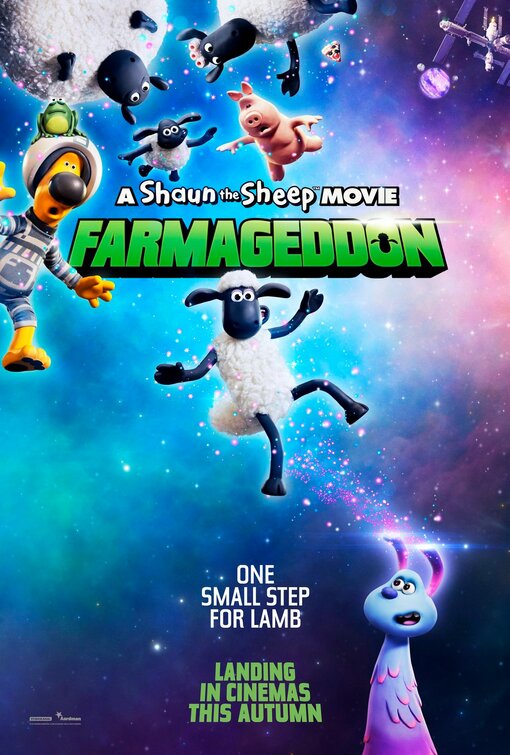
Movie Review: A Shaun the Sheep Movie: Farmageddon

A Shaun the Sheep Movie: Farmageddon **** / *****
Directed by: Will Becher and Richard Phelan.
Written by: Jon Brown and Mark Burton and Nick Park based on characters created by Park.
Starring: Justin Fletcher (Shaun / Timmy), John Sparkes (The Farmer / Bitzer), Chris Morrell (Farmer John), Andy Nyman (Nuts), David Holt (Muggins), Kate Harbour (Agent Red / Timmy's Mum), Amalia Vitale (Lu-La), Joe Sugg (Pizza Delivery Boy).
 
Sometimes, it feels as if the universe is laughing at you, doesn’t it? A week after I saw the horribly cynical Sonic the Hedgehog – a crass commercial enterprise in brand extension disguised as children’s entertainment, I saw the utterly delightful A Shaun the Sheep Movie: Farmageddon. The plot of the two movies is virtually identical – an alien creature has to go on the run with an earthling, on the run from a government agent who wants to capture the alien – but other than that, the two films couldn’t be more different. Whereas Sonic the Hedgehog has nothing on its mind other than empty nostalgia, Farmageddon is a delightful film with influences from the entire history of animation and silent film comedians like Tati, Keaton, Lloyd and Chaplin (including a direct reference to Chaplin’s Modern Times). It is children’s entertainment done right – sweet, without being saccharine, funny without being cynical or depending on pop culture references. While Sonic is making a ton of money at the box office however, Farmageddon has been quietly dumped to Netflix. There is no justice in the world.
 
Shaun the Sheep is, of course, the franchise from Aardman – that wonderful British animation studio best known for Wallace and Gromit. Shaun the Sheep is a long running TV franchise – easily translatable around the world, because basically there’s no dialogue at all – the animals sound like animals, if they make any noises at all (which they don’t often do) and the humans speak in gibberish – as if it’s what those animals are hearing. The first Shaun the Sheep movie came out in 2015 – and was even better than this, a pure delight for children. It didn’t make any money in North America – because we’re idiots – which explains why this film, which played in theatres everywhere else late last year – was dumped to Netflix here, where its audience will not find it.
 
This time, our hero sheep has to team up with Lu-La, an alien child, who accidentally crash landed on earth, who wants nothing more than to get back to their mom and dad. To do this, Lu-La and Shaun go on the run to try and recover their spaceship – and have all kinds of hilarious adventures – a stop at a grocery store, where Lu-La discovers candy and soda is a particular delight. The Farmer, Shaun’s oblivious owner, decides he wants to capitalize on the alien craze by building a theme park. And a government agent is chasing down Lu-La, to try and prove her lifelong obsession with aliens isn’t fruitless.
 
The film is a sweet delight from beginning to end. Aardman knows precisely what they are doing, precisely how to reach children – probably smaller children, for whom a lot of “funny” dialogue is meaningless. The ambitions here are not great – just making very funny, sweet children’s entertainment – that is also incredibly smart for the adults in the crowd. It’s a mixture that sounds easy but is very hard – but something Aardman does better than just about anyone.
 
So please, see A Shaun the Sheep Movie: Farmageddon – and show yours kids. You’ll both be delighted by the film, and they’ll get way more out of it than they will from Sonic. And so will you. Trust me, you’ll thank me later.

Movie Review: The Last Thing He Wanted

The Last Thing He Wanted * ½ / *****
Directed by: Dee Rees.
Written by: Dee Rees and Marco Villalobos based on the novel by Joan Didion.
Starring: Anne Hathaway (Elena McMahon), Ben Affleck (Treat Morrison), Rosie Perez (Alma Guerrero), Edi Gathegi (Jones), Mel Rodriguez (Barry Sedlow), Toby Jones (Paul Schuster), Willem Dafoe (Richard McMahon), Carlos Leal (Max Epperson), Julian Gamble (Secretary George Schultz).
 
Dee Rees is an incredibly talented director – her first two features – Pariah and Mudbound – are both excellent, both personal, although Mudbound has a more epic scope than Pariah did. Her films are expertly crafted – they look amazing – and generally she gets great performances out of her casts. I preface this review of her latest film – The Last Thing He Wanted – by saying all of this, because Rees latest film is pretty much a disaster. It is the most poorly plotted film in recent memory – a film that gets increasingly confusing as it moves along, before ending with a horrible final scene, and laughable final shot. Rees is still an immensely talented filmmaker – but The Last Thing He Wanted is a terrible movie.
 
The film stars Anne Hathaway as Elena McMahon, a reporter for a fictional, Washington based paper. It’s the early 1980s, and she is doing important work in Nicaragua, before she is quite literally chased out of the country. She is working on a story of the Contras, and their relationship with Reagan, etc. – but her bosses don’t want that story – they want her covering the upcoming election. Then, through a series of strange coincidences, she finds a personal connection to the contras and that story through her father – Richard (Willem Dafoe). He’s running some guns down to South America – of course – but he’s also very ill. He cannot make the necessary trips – so Elena ends up going in his place. This is essentially the setup for the film – and it takes half its runtime to get there. Once that trip begins though, and Elena heads down to South America, the entire film flies off the rails.
 
I will say this – Hathaway is acting her ass off in this film – trying her best to find a consistent character to play, and never quite finding it. Not that it’s her fault – the movie tries to give her several relatable humanizing elements – a divorce, a daughter she loves, but is distant from, breast cancer survivor, the recent death of her mother, her complicated relationship with her father, etc. – but none of them really work (seriously, the daughter, the cancer and the dead mother are basically afterthoughts). None of it really explains the central question that the movie fails to answer – why the hell she agreed to go to South America and essentially become an arms dealer for her father. The film never really answers this question – and so the whole movie has this question hanging over its head.
 
Still, the film could have worked except for the fact that the entire second half of it makes absolutely no sense and is essentially a series of one confusing scene after another. We are introduced to character after character – Ben Affleck’s emotionless CIA agent, who becomes a love interest of sorts of Elena, an arms dealer named Jones (Edi Gathegi), whose motivations seemingly change minute to minute, and worst of all an ex-pat who owns a hotel (Toby Jones) who waxes poetic endlessly about nothing – who Elena ends up working for getting newspapers and cleaning up (why – I HAVE NO IDEA).
 
The Last Thing He Wanted ends up being that rare film that somehow manages to be confusing beginning to end, and also almost all endless exposition. When characters are constantly explaining things to you, you would think it would impossible for it to be this confusing. You’d be wrong.
 
The film is based on a novel by the great Joan Didion. I haven’t read this novel, but Didion is a genius writer – but perhaps not one destined to be adapted for the screen. Perhaps the dialogue doesn’t come across as tin eared on the page as it does in these actors’ mouths. Perhaps she finds a way to make this convoluted series of plot twists and turns – and character twists and turns – not seem so arbitrary and confusing. Perhaps she makes you care about something. The movie does none of those things. Yes, Hathaway does what she can here – as does Dafoe (although, it’s the stereotypical Dafoe role) and some others (I always liked Rosie Perez, was disappointed when she disappeared from Hollywood, and am heartened that she’s back – but she’s given nothing to do here). The film also looks beautiful, as it hops from one tropical locale to the next. And yet, it’s a complete and total mess – almost as if the original cut of the movie was about 4 hours, and they just random cut half of it, and hoped you could follow along. Good luck with that.

Movie Review: Come to Daddy

Come to Daddy *** / *****
Directed by: Ant Timpson.
Written by: Toby Harvard and Ant Timpson.
Starring: Elijah Wood (Norval Greenwood), Stephen McHattie (Gordon), Garfield Wilson (Ronald Plum), Madeleine Sami (Gladys), Martin Donovan (Brian), Michael Smiley (Jethro), Simon Chin (Dandy), Ona Grauer (Precious), Ryan Beil (Danny), Oliver Wilson (Young Norval).  
 
There is a skill involved in being an actor at the center of a film as ridiculous as Come to Daddy and making it all work – a skill that Elijah Wood has honed in the years since The Lord of the Rings ended, and Hollywood clearly had no idea what to do with him. Wood has spent much of that time making low budget horror films – so good, so not so much – but he’s clearly found a way to make even the strangest of films seem plausible – a skill many don’t have. It’s key to Come to Daddy, because this is a ridiculous film in many ways, it’s so much fun in part because Wood plays it so straight.
 
In the film, Wood plays Norval Greenwood, a young man who grew up in Beverley Hills, the child of an eccentric mother, and an absent father that he doesn’t even remember. Now, the old man is getting on in years, and has sent Norval a letter, telling him to come to his remote home in the middle of the woods, so the two can get to know each and bond finally. And yet, when Norval arrives, he finds his father (Stephen McHattie) doesn’t really seem to care that he’s there – doesn’t seem to remember he invited him, and spends all of his time mocking and belittling Norval – sometimes with some good reason, but that doesn’t make him an less of an asshole.
 
I won’t say any more about the plot, because Come to Daddy is able to twist and turn itself into some very unexpected places as it moves along, pulling off these twists. For the first half of the film, it is essentially a two hander between Wood and McHattie – and it’s a wonderful one at that. McHattie is one of those character actors I always take delight in seeing – he doesn’t often get roles this good, but he relishes them when he gets them. He delights in tormenting Norval – the way he prods him, the way he listens to his son talking about his drinking problem, before making a big show of drinking himself, the way he doesn’t care about Wood’s fancy phone, etc. McHattie is having a blast – and it’s fun to see him.
 
The film grows more and more far-fetched in the second half – delightedly so however, as it’s the type of film where one thing leads to another to another to another, all increasingly strange and unbelievable, but just one after another. The film is a dark comedy and a thriller, and a bloody horror movie, and other things as well. It is the directorial debut of Ant Timpson, and I suppose he deserved credit for keeping the whole thing on the tracks, when it so easily could have flown off at any point.
 
Wood deserves credit too though. He plays a character who isn’t entirely sympathetic – he is a liar and rather weak willed, and is 35, and hasn’t done anything with his privilege. And yet, you like him anyway – you cheer for him anyway, if for no other reason than everyone else is way worse. It’s a fine performance by Wood – and it keeps the whole thing humming along nicely.

Movie Review: After Midnight

After Midnight *** ½ / *****
Directed by: Jeremy Gardner & Christian Stella.
Written by: Jeremy Gardner.
Starring: Jeremy Gardner (Hank), Brea Grant (Abby), Henry Zebrowski (Wade), Justin Benson (Shane), Ashley Song (Jess), Nicola Masciotra (Pam), Taylor Zaudtke (Jane), Keith Arbuthnot (Monster).
 
Hank and Abby have been together for a decade – living somewhere in rural Florida where they run a bar together, and rambling around a big, dilapidated house that Hank always says he will fix up, and never does. They aren’t married, they don’t have kids – and Hank seems okay with that. He has his bar, his booze, his friends, his hunting and his girl – what else could he want. But early in After Midnight, Abby leaves – there’s a note that says she needs to get away for a while, but that she loves him. She hasn’t answered her phone since. And every night, after midnight, something comes to Hank’s door – scratching and clawing, and trying to get in. Of course, no one believes him.
 
After Midnight could probably best be described then as an indie version of one of those Judd Apatow movies where the slacker finally realizes he needs to grow up, but stripped of the comedy, and adding in some horror elements – as it really does seem like something wants in that house. As time passes – days become weeks, with no Abby, Hank’s grip on his sanity starts to slip even more – no one quite believes he has seen what he says he’s seen, although there’s something. Maybe a bear, or a panther – never mind that no one has really seen one of those around. The film alternates between flashes of Hank and Abby during happier times – although it slowly becomes clear that Hank is oblivious to Abby’s growing restlessness – and scenes in the present, of Hank either dealing with this monster, or telling people about it, and having them not believing it.
 
When I describe it that way, it doesn’t really sound like After Midnight should work very well – and yet it does. A large part of that goes to writer/co-director/star Gardner’s performance as Hank. It isn’t a flashy performance, and he never tries to do too much – but he’s excellent as this man who is clearly hurt by Abby’s abandonment, but doesn’t really know how to process it, and doesn’t want his friends know he’s hurting at all. It’s not really a portrait of toxic masculinity – one of the more impressive scenes is between Hank and Abby when she returns – and he listens to her, while still being hurt. It’s a portrait of a man who doesn’t want anything to change – but seemingly has everything the way he wants it, and so he doesn’t rock the boat. But that leads to stagnation.
 
Horror fans will likely be disappointed here – it’s not really a horror film, with the monster being a metaphor, which isn’t anything new (hell, is The Badadook one giant metaphor) – but it’s clear that the filmmakers aren’t really interested in it at all. So for most of its runtime, After Midnight is a pretty good film, well-acted, written and directed, if somewhat forgettable – but it has a scene at the end that while incredibly cheesy, I absolutely loved, so it elevated the whole film for me. An interesting little indie curio to be sure.

Movie Review: The Cave

The Cave **** / *****
Directed by: Feras Fayyad
Written by: Alisar Hasan, Feras Fayyad.
 
The Cave is one of those rare movies that can both inspire you and devastate you about your fellow humans. It is a film about selfless heroes, working in an underground hospital in Syria, tending to the wounded who are able to make it there – through a series of underground tunnels – even though the odds they face are staggering. Lots of people are dragged there, and it’s already too late for them – many others don’t have much hope. Most of the doctors in the area have already fled – but some have stayed, a few students, quite of few of them women, and they do their best to save lives, comfort children, and just try and get their people through another day. It is inspiring to see their selflessness. The film can also leave you feeling hopeless and depressed – for all of their work, things still do not end well.
 
The film was directed by Feras Fayyad, who also directed Last Men in Aleppo (2017) – which, like The Cave, was an Oscar nominee for Best Documentary. That film was about volunteer with the White Helmets – the team who went around in Aleppo after bombings, and tried to dig survivors out of the rubble to save their lives – and another of those films that can leave you inspired and crushed at the same time. This time, the film takes place in Eastern Ghouta – but the situation is basically the same. The Syrian regime, and their Russian backers, are bombing the civilian population to get at the rebels, causing a massive humanitarian crisis, which the rest of the world thinks is really very sad, but hasn’t really done anything about.
 
The central figure in The Cave is Dr. Amani Ballour, a pediatrician, who is one of the young, female doctors who have stayed behind to staff this hospital. She has a lot of patience in her – doesn’t even get mad at the male patients who get mad at her, wishing there was a male doctor managing the hospital, and telling her that her place should be at home raising children (you would think they would be grateful for the assistance – but you’d be wrong). She is kind and patient – does her best to save as many lives as possible, to comfort the children who come in screaming and crying and covered in dust and blood. You cannot say that she is upbeat or optimistic – but she certainly doesn’t give up.
 
As with any movie about Syria, there are moments and shots that you cannot forget, that engrave themselves into your brain, and won’t let go – the other wailing over her dead son, angry at him for dying for instance. The film also covers the panic and devastation that resulted when the government gasses their own people – how the hospital had to deal with the people effected and protect those who were not.
 
The film was released the same year as another wonderful documentary about Syria – For Sama – which is also about the selfless actions of doctors trying to save lives, and specifically how it is women who are doing a lot of the front-line work. Both films are wonderful – and should be seen – even if both basically end the same way – with the only thing left to do is leave if you can. The Syrian humanitarian crisis has been well-documented for years now – I’ve lost count of how many documentaries on it I have seen by this point. In the future, we marvel, and feel ashamed, of just how little we did.

Movie Review: Mickey and the Bear

Mickey and the Bear **** / *****
Directed by: Annabelle Attanasio.
Written by: Annabelle Attanasio.
Starring: Camila Morrone (Mickey Peck), James Badge Dale (Hank Peck), Calvin Demba (Wyatt Hughes), Ben Rosenfield (Aron Church), Rebecca Henderson (Leslee Watkins). 
 
After re-watching Five Easy Pieces (1970) for the first time in years a few weeks ago (spoiler alert – it’s still a masterpiece), I re-read Roger Ebert’s Great Movies Essay about that film from 2003, and was struck by Ebert calling it the “first Sundance movie” – in part because in the years since Ebert wrote that, Sundance movie has become almost as cliched as mainstream movies – as they’re always full of movie stars, looking for some cred, by acting in a quirky film (I generalize, of course, but so many times out of Sundance we hear about a surefire audience hit, only for it to get ignored when it comes out a few months later, as it’s the same as last year’s surefire hit, that was also ignored). I bring this up at the beginning of a review of Annabelle Attanasio’s Mickey and the Bear, not because it’s as good as Five Easy Pieces (it isn’t) – but because I think that like Five Easy Pieces, it wouldn’t fit in as nicely in the Sundance of 2020 as it would have when Ebert wrote his great movie essay. Mickey and the Bear is the type of movie that Sundance would deem “too small” (which is why it’s a SXSW film), too small for something like the Independent Spirit Awards, and basically too small for most audiences to ever hear of the film – which is why, despite good reviews last fall, it basically came and went from theaters quickly without attracting much notice, and is now streaming, where too few people will watch it. It is a small film – but it’s a real film, in that it’s a film about real people, dealing with their real lives. As small as that is, it taps into something all too rare in movies these days – that everyday drama can still make for great movies.
 
Mickey is played by Camilla Morrone, and she’s a just turned 18-year-old girl from Anaconda, Montana – who outwardly seems satisfied with her small town life, her smalltown boyfriend, and what promises to be a small-town life. Her mother died of cancer a few years ago, and her father, Hank (James Badge Dale) is an Iraq war veteran, suffering from PTSD, is an alcoholic and addicted to oxycontin, and basically doesn’t leave their trailer, where he plays video games all day, unless it’s to go drinking. Mickey meanwhile goes to high school, holds down a job, and takes care of Hank – who tries to be very fun, very cool, but is an insecure mess.
 
Mickey does have bigger dreams for herself though – even if she doesn’t let anyone know about them. They are small in the grand scheme of things – a plan to go to San Diego City College, and leave this behind, but she worries about leaving. Will she be good enough? Will she have enough money? What will become of Hank without her? When she meets Wyatt (Calvin Demba), a transplant from the UK, she starts making small moves away from that small-town life, but will she really pull away.
 
The movie is no more dramatic than that really. Her friend is already pregnant – already has her life set ahead of her, and Mickey sees that her life with Aron will basically be the same. Hank makes fun of Aron but is clearly not threatened by him in any real way – if Mickey is with him, that means Mickey is still here. He is threatened by Wyatt however – which makes him act in more extreme ways with him.
 
The performances here are key. Morrone is excellent in the first movie role I will remember her for (apparently, she was in Eli Roth’s Death Wish – but I have already forgotten that film). What she does here is sensitive, subtle, quiet and devastating. Dale is just as good as Hank – an insecure mess of a man. Yes, you feel sorry for him – and you should – but over the course of the movie, as you see more sides of him, you realize he doesn’t even want to get better – isn’t even trying. You expect there to be a scene where he encourages Mickey to leave him for her own good, but what you get the exact opposite – him begging her to stay. In a small role Rebecca Henderson is excellent as the psychiatrist at the hospital that Hank refuses to see – she knows precisely who he is.
 
The film is the directorial debut of Annabelle Attanasio, and it’s an excellent debut. She has confidence in her screenplay, and her actors – she holds shot a beat longer than you may expect, and they sink in. I think the ending perhaps pushes a little too far – there is a lot that happens in a single cut that the film doesn’t explain, but I kind of feel it should have – it pushes a little too hard. But it’s that push that Mickey needs. She can stay in Anaconda and have nothing – or she can at least try to get out. That can be messy and can involve doing things that hurt others – but at some point, you have to choose between hurting them, and hurting yourself.