Showing posts with label Joseph Losey. Show all posts

Friday, May 1, 2020

Double Classic Movie Review: M (1931 & 1951)

M (1931)
Directed by: Fritz Lang.
Written by: Thea von Harbou and Fritz Lang.
Starring: Peter Lorre (Hans Beckert), Ellen Widmann (Frau Beckmann), Inge Landgut (Elsie Beckmann), Otto Wernicke (Inspector Karl Lohmann), Theodor Loos (Inspector Groeber), Gustaf Gründgens (Schränker), Friedrich Gnaß (Franz), Fritz Odemar (The Cheater), Paul Kemp (Pickpocket with Six Watches), Theo Lingen (Bauernfänger), Rudolf Blümner (Beckert's Defender), Georg John (Blind Panhandler), Franz Stein (Minister), Ernst Stahl-Nachbaur (Police Chief), Gerhard Bienert (Criminal Secretary), Karl Platen (Damowitz), Rosa Valetti (Bartender), Hertha von Walther (Prostitute). 
 
M (1951)
Directed by: Joseph Losey.
Written by: Norman Reilly Raine & Leo Katcher and Waldo Salt.
Starring: David Wayne (Martin W. Harrow), Howard Da Silva (Inspector Carney), Martin Gabel (Charlie Marshall), Luther Adler (Dan Langley), Steve Brodie (Police Lt. Becker), Raymond Burr (Pottsy), Glenn Anders (Riggert), Norman Lloyd (Sutro), Walter Burke (MacMahan), John Miljan (Blind Baloon Vendor), Roy Engel (Police Chief Regan), Janine Perreau (The Last Little Girl), Leonard Bremen (Lemke), Benny Burt (Jansen), Bernard Szold (Bradbury Bldg. Watchman), Robin Fletcher (Elsie Coster), Karen Morley (Mrs. Coster), Jim Backus (The Mayor), Jorja Curtright (Mrs. Stewart), Frances Karath (Little Girl in Hallway).
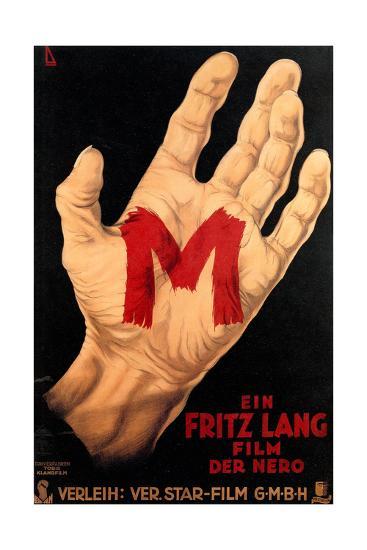
 
Fritz Lang’s M is one of the greatest of all films – and its influence cannot be overstated. It is one of the great early sound films – in large part because unlike many in the early years of sound, Lang didn’t go overboard with sound – he used it brilliantly but wasn’t afraid of long stretches of silence. He emphasized visuals above all – and his film is full of amazing camera work. You can see the influence – like much of German Expressionism films – on film noir, in its visuals, but also in its storytelling. It is also a film that you can trace many in the “serial killer” drama to as well – offering a complex portrait of a monster of the worst kind – a man who kills children. It is a portrait of Germany at the time Lang made it – he was only a couple years away from fleeing Germany for Hollywood at this time, the roots of Nazism was surely already there. Every time I watch it, I am truly amazed that Lang made the film he did, when he did, how he did – and it remains a masterpiece, the best film in Lang’s long, brilliant career – and one of the best films ever made.
 
Lang’s film is about a child killer who is terrorizing Berlin – as one child after another has gone missing, and the city has descended into panic. The film’s opening act is about that panic – and Lang is at his best when he can suggest so much, while showing us so little. His killer is defined by his whistle more than anything else. When we watch him take a child away – poor little Elsie Beckmann, he does it with ease and confidence – and we don’t see a whole lot. When poor Elsie is dead, Lang shows us that with a few quick shots – the balloon she was holding lost in a mess of wires, the ball she was bouncing rolling away and being left. We are shown nothing but know everything. Lang is able to show us the mounting sense of paranoia in the city – both on the streets, and in homes. The police, who have no idea how to stop this criminal, decide instead to try and stop all the other criminals – they crack down on all the underworld enterprises going on. To make matter worse for the criminals, others are staying away anyway – scared for their families. The second act is really a procedural more than anything else – but a duel one. The police are taking one track to trying, and the criminals a much different, much more brutal track. It all comes to a head at a soulless factory – that the criminals have tracked the killer to and have cornered inside.
 
Lang’s use of visuals and sound in M are a landmark for the time. It is true that many early sound films have stretches of silence in them – it was easier to do that then, and it was common. But Lang uses sound in a way that makes you think he would have done this regardless. He uses strange angles throughout the film – his camera always lurking, peering around corners, up from strange angles, stalking its characters, as if spying on them the entire time. The sound we hear if often what tells us what we need to know – but the camera is a little behind, not quite seeing, what we are hearing, which is out of frame. So, when the sound drops out, the tension mounts – and you listen closely, waiting for the next piece of sound that will tell us something.
 
M is also innovative in its depiction of its serial killer – brilliantly played in his breakthrough role by Peter Lorre, who like Lang, would flee Germany for America. We don’t quite get a good look at him – and he’s terrifying. When we finally do – when the blind beggars recognize him by his whistle, and mark him for others to follow, Lorre becomes a frightened, pathetic little man – a trapped rat. Lang does something daring – you don’t sympathize with him really, but you do empathize – it is terrifying to have all these criminals chasing you, closing in, having no where to go. Lang doesn’t explain him either – he leaves a lot of clues, but lets them dangle – leaving you to piece together what is real, and what isn’t in what he says and does – does he taunt the police with his letter, or want to be caught. Is his impassioned plea legitimate, or a last ditch effort to save his life? Lang is interested in it sure – but M ultimately is about mob mentality – something Lang returned to again and again in his career. The mob here may well have a point – that Lorre’s serial killer is evil, and needs to be stopped – but they aren’t exactly good guys either, or they take things too far. And its not like the police are corrupt or incompetent – the criminals find him first, but the cops have their own methods, and would have got to him soon. The film doesn’t even tell us the killer’s ultimate fate.
 
20 years after Lang’s M, the producer of that film, who also came to Hollywood, decided it was time to remake the film – and approached Lang to direct an American version. Lang, correctly, felt there was nothing he could better on a remake, so he passed. The job eventually fell to another great director, who would shortly after making M leave his home country – Joseph Losey. But unlike Lang when he made M, Losey was not yet at the height of his powers – he is best known for films like The Servant and Accident which he made in the 1960s – in the 1950s, Losey was a young director, still looking to establish himself. The Blacklist would drive him out of Hollywood not long after he made M – and if you can see some of Lang’s politics (that he denied were there) about his country when he made M, you can see Losey’s Communist influence on his version of M.
 
For better or for worse, Losey seems to agree with Lang that there is little he can do to improve on M – and there are whole sequences that are virtually shot for shot, word for word to Lang’s film. If there’s a difference, it’s that Losey shot on location, on the streets of Los Angeles, not a sound stage like Lang did. This does lend a rawness to Losey’s film – but he also clearly didn’t have the complete control that Lang did. David Wayne would play the killer this time – no whistling this time, but a recorder instead – making him even more of a Pied Piper character. Mostly, the two films are very similar – there is a very Freudian scene in Losey’s version – where he literally cuts the head off of a makeshift doll of a child with a picture of his mother in the background, and his plea for mercy is a little more psychological as well – but in terms of plot, it’s basically the same. Losey makes great use of the Bradbury Building – although I kind of like the soulless drabness of the building in Lang’s film. And it’s not completely fair to say Losey just copies Lang – there are interesting touches here and there, differing details that place it in America in the 1950s, not Germany in the 1930s – but for the most part, the translation is an easy one.
 
But, still, there is a reason why Lang’s film is considered a masterpiece – one of the best films ever made – and a lot of people don’t even know that Losey remade it at all. It isn’t the easiest film to find – I had to PVR it late one night off of TCM to see it after years of being curious about it. Losey’s film is good – a fine 1950s American Noir, with some nice touches and performances. But it really doesn’t come close to matching Lang’s film – with its utter strangeness, the unique angles, use of sound, strange villain, and portrait of mob rule. Lang’s film is a masterpiece – and Losey’s is a curiosity. Perhaps had Losey made it later in his career – and tried to make it his own more than he does here, it could have been – if not an equal to Lang’s film, than at least a more compelling second half of the double bill. It’s a good film – but Lang’s is one of the greatest ever made.

Thursday, December 1, 2011

The Best Films I Have Never Seen Before: The Go-Between (1971)

The Go-Between (1971) ****
Directed by: Joseph Losey.
Written by: Harold Pinter based on the novel by L.P. Hartley.
Starring:  Julie Christie (Marian - Lady Trimingham), Alan Bates (Ted Burgess), Margaret Leighton (Mrs. Maudsley), Michael Redgrave (Leo Colston), Dominic Guard ('Leo' Colston), Michael Gough (Mr. Maudsley), Edward Fox (Hugh Trimingham), Richard Gibson (Marcus).

On the surface, The Go-Between resembles many other films. It is about a relationship between an upper class British woman, Marian (Julie Christie) and a lower class farmer, Ted (Alan Bates) who truly do love each other, but can never be together because of their difference in class. This has been a standard story in British literature for as long as there has been such a thing. And yet, Joseph Losey’s The Go-Between is still a stunning film. Harold Pinter adapted L.P. Hartley’s novel, which looks at this relationship over one summer through the eyes of a 12 year old boy – and how the consequences of what happened that summer reverberates through the years, forever scarring everyone involved.

The film stars young Dominic Guard as Leo, who is school friends with Marcus (Richard Gibson) and is invited to spend the summer with them. Leo is middle class, doesn’t have all the advantages or money that Marcus does, and at first, he seems at awe of their huge estate. The family is nice, if a little condescending towards him – especially Marian, who takes a shine to Leo, even going so far as to take him into town to buy him a summer suit, when it becomes clear that he does not own one. Leo is smitten with Marian, and will do anything for her. Something she uses to her advantage. Things really get started when Marcus gets sick and has to stay in bed all day – leaving Leo to wonder the countryside by himself. One day he ends up stumbling upon the farm on the family land that is rented to Ted Burgess. Ted is nice to Leo, but also probes him with questions. Does he ever see Marian alone? Could he take her a letter without anyone else seeing it? Leo doesn’t understand the implications of this before it is too late. Soon, he is running back and forth almost daily with letters between the two lovers. He becomes confused when he is told that Marian is going to marry not Ted, but Hugh Trimingham (Edward Fox), the scarred war hero with a title. He will eventually ask Marian why she cannot marry Ted. She simply replies “I cannot”. When he follows this up by asking her why she is marrying Hugh she simply says “Because I must”. It won’t be until the end of the film when all of this comes together.

The Go-Between is an expertly calibrated mood piece. Losey has an eye for period detail, and everything in the film looks just right. The cinematography by Gerry Fisher is expert, with a camera that is constantly moving, constantly watching. The score by Michael Legrand is ever present, and sets the tone. Like the previous Losey-Pinter collaboration, The Go-Between experiments with time, flashing forward to the end of the story, or the epilogue, during the second half of the film, rather than simply using it as a bookend. This helps to put the cause and effects next to each other, to see what will become of the characters, and why, as it happens.

Pinter’s screenplay here is one of his best. It is one where what isn’t said is emphasized – one where we get layers that fly right over poor, young, naïve Leo’s head. The lovers may be older than they were intended to be (Julie Christie was almost 30, and Marian was originally written as a teenager), but this adds to the sad poignancy of her character. She has not yet married, she is in love for the first time in her life, but instead of being able to pursue that love, she is stuck with Hugh. One of the nice things about the film is that Hugh is not portrayed as a bad guy. He is nice to Leo – nicer than most of the rest of the family. It isn’t his fault that Marian is in love with someone else.

The performances work beautifully. Dominic Guard is wonderful as the child on the brink of sexual awakening, but still naïve about it. Julie Christie is wonderful as the tragic heroine – caught between what she wants and what she is expected to do. Alan Bates is in fine form as the lower class farmer, who nonetheless is kind and gentle. And Margaret Leighton is magnificent as Christie’s mother, who knows far more than she lets on.

Out of the three Losey-Pinter collaborations, I think The Go-Between is probably the weakest. It doesn’t quite have the subversive kick of The Servant (1963) or the complexity of Accident (1967). And yet, it is still a great film. These two simply knew how to bring the best out of each other – push each other farther. It is one of the best writer-director collaborations in film history.

Friday, November 18, 2011

The Best Films I Have Never Seen Before: Accident (1967)

Accident (1967) ****
Directed by: Joseph Losey.
Written by: Harold Pinter based on the novel by Nicholas Mosley.
Starring: Dirk Bogarde (Stephen), Stanley Baker (Charley), Jacqueline Sassard (Anna), Michael York (William), Vivien Merchant (Rosalind), Delphine Seyrig (Francesca), Alexander Knox (Provost), Ann Firbank (Laura).

Joseph Losey and Harold Pinter’s second collaboration following The Servant (1963) but before The Go-Between (1971) is probably the least remembered of the three films they made together. I haven’t seen The Go-Between yet, so I cannot comment on that one, but I think the reason why Accident isn’t quite as highly regarded as The Servant is because it’s more complex, more dense, less immediately satisfying than the previous film. This isn’t to say that it isn’t as good as The Servant – in some ways, it’s better, and is certainly more daring, just that Accident is a harder film to try and wrap your head around.

Like The Servant, Accident is essentially about people destroying each other while maintaining a mask of civility. I don’t think any of the characters in Accident – especially the male ones – like each other very much at all. Yet on the outside, they maintain a façade of pleasantness to one another. No one gets into a fight during the course of Accident – I’m not sure anyone even raises their voice - but lives are certainly ruined.

The film stars Dirk Bogarde in another of his great performances, as Stephen, a seemingly happily married Oxford don, specializing in philosophy. He has been tutoring William (Michael York) for a while now, and they have a friendly student-teacher relationship. Stephen’s new pupil is Anna (Jacqueline Sassard), a beautiful Bulgarian “princess”, who William is enamored with – but then again so is Stephen. William wants Stephen to introduce the two of them, and although he doesn’t, William and Anna start dating anyway. Being nice, Stephen invites the two of them to his country house to meet his wife Rosalind (Vivien Merchant) and his two young children. Unexpectedly, Charley (Stanley Baker), another Oxford don – but a more famous and successful one – arrives to visit his “friends” Stephen and Rosalind. He hints at marital discord in his own relationship – and like Stephen and William, also “falls in love” with Anna.

Anna is a typical Harold Pinter creation – a blank slate of a character that everyone else projects their own vision upon. Other than her beauty, there is nothing at all that defines her as a character. We never get to know the real person that lies beyond that beauty. That is mainly because the movie is told from Stephen’s point of view – everything we see comes from him. And he never really bothers to get to know Anna – he simply falls in love with her beauty. Why she is with William, and later why she starts an affair with Charley, is never made clear. The reasons for her actions are often murky – so much so that we cannot even tell if her actions in the title accident are really an accident at all. She defies explanation. I do not mean this as an insult on the movie, because that is what her purpose is. Without her, the male characters who probably simply trade banal, meaningless pleasantries with each other for the whole movie. With her, those banal, pleasantries become loaded with resentment and contempt. I’m not sure when it becomes clear that Stephen and Charley truly hate each other – despite being lifelong “friends” – but it certainly become clear over the course of the movie. I think perhaps it’s in a scene where Stephen comes back to his house in London, which he believes to be empty – to find that it is in fact occupied by Anna and Stephen, having one of their rendezvous, that up until that point, Stephen did not know about. Watch that scene to see the way Stephen bends over backwards to be polite to the two of them, and yet how every phrase is dripping with hatred for Stephen, and regret for not having bed Anna himself. It is a masterful moment for Pinter, Losey and Bogarde.

With Accident, director Joseph Losey pushes himself beyond where he was with The Servant. He and Pinter play with time more in this film – events happen out of chronological order, and the end swoops back around to the beginning of the film, and gives everything in it an entirely different meaning. The strange, off kilter cinematography, that lingers in empty rooms after the characters have left, the editing which sets the tone, and sound design which is haunting, is all interesting and unique. Unlike many directors in the 1960s, whose experiments in style where largely meaningless and an attempt to be cool, Losey’s visual experiments are perfect for Pinter’s sparse screenplay.

The performances help a great deal as well. You will not a see a better performance of repressed sexuality than that given by Dirk Bogarde in this film. It easily matches his brilliant work in The Servant, yet could not be more different. He comes across as rather pathetic by the end, but at least we feel sympathy for him. Stanley Baker as Charley, on the other hand, is even more pathetic in the end, and there is no sympathy for him. He seems to have it all – or at least all that Stephen wants – but he is an empty shell. In his first major role, Michael York is fine as the handsome, young William – who again Stephen envies. Vivien Merchant gives her few scenes as Stephen’s wife, who knows what is going on, but wouldn’t dream of saying anything about it, a nice bite. Poor Jacqueline Sassard is cast more for her physical presence than anything else – but she does what she has been asked to do.

Accident is a complex film. Its mysteries don’t readily reveal themselves, and instead the movie trusts the audience to do the digging into what is on screen. The film is not as famous as The Servant – but it is every bit as good.

Wednesday, November 9, 2011

The Best Movies I've Never Seen Before: The Servant (1963)

The Servant (1963) ****
Directed by: Joseph Losey.
Written by: Harold Pinter based on the novel by Robin Maugham.
Starring: Dirk Bogarde (Hugo Barrett), James Fox (Tony), Sarah Miles (Vera), Wendy Craig (Susan).

Joseph Losey and Harold Pinter collaborated on three movies in the 1960s and 1970s – the first, and perhaps most highly regarded of these three was 1963’s The Servant. This is a devastating movie about a manservant named Barrett (Dirk Bogarde) who takes it upon himself to destroy his new employer – Tony (James Fox). The film was seen at the time of its release as a statement on Britain’s crumbling class system – with Fox’s Tony an oblivious, idle rich twit, still clinging to the old ideas of British aristocracy in taking on a “manservant” in Barrett, when the whole profession was already outdated. That Barrett so thoroughly and completely destroys Tony, was read as a victory of the working class. I’m not so sure that’s what is really going here. I may know little about Harold Pinter, but what I do know is that his work favors personal relationships over political commentary. That his work (like Accident, the second Losey-Pinter collaboration) which I will review shortly for this series) is more about the horrible things people do to each other while maintaining an outward visage of civility. That certainly applies to The Servant.

When the movie opens, we are presented with Tony as an upper class young man, who has just come into his inheritance. He has “very important” business dealings, that take up all of his time – although he still finds time to nap at three in the afternoon – and has bought a fashionable house, but needs someone to take care of it. In walks Barrett, who seems to be a gift from heaven. He oversees the decorating of the house, so Tony does not have to bother, and everything else. He cooks, he cleans, he locks up at night, he in short, does everything, leaving Tony with little to do. Tony loves Barrett for doing all of this. The only problem is that Tony’s fiancée Susan (Wendy Craig) hates Barrett. Why she does, is something that even she cannot put her finger on. After all, he is only doing his job – but he just always seems to be there – hovering around the house. She wants Tony all to herself, and asks him to fire Barrett. But that would mean Tony would have to do everything that Barrett does himself – and we can’t have that can we.

Having already succeeded in driving a wedge between Tony and Susan, Barrett goes one step further and convinces Tony to hire his “sister” Vera (Sarah Miles) to be the housekeeper. Vera is the opposite of Susan in every way – unrefined and clumsy – and yet she is undeniably sexy. Barrett practically throws her at Tony, but of course in a subtle way. The affair will be just what Barrett needs to blow up Tony’s life.

Dirk Bogarde is one of those actors who was capable of doing so much, while seemingly doing nothing. In the scenes at the beginning of The Servant, he seems to be the most prim and proper manservant in movie history. So attentive to detail. And yet, there is something supremely unsettling about him as well – something that we catch in his eyes, in quiet moments of him going about his work. Like Susan, we don’t trust him, but we do not know why. It truly is a terrific performance by Bogarde, and without it, the film wouldn’t work. For his part, James Fox is perfectly cast as the upper class twit Tony, oblivious to his own fate even as everything comes crashing down around him. Sarah Miles is terrific as the “sister”, manipulating Tony with her brash sexuality, but also being manipulated in return by Barrett. And Wendy Craig, although she has the most thankless role in the film, fills out the cast nicely.

Joseph Losey was blacklisted in the McCarthy trials of the 1950s, and found his way to England, where he struggled to get his career going again. But when he teamed up with Harold Pinter, he found his dream collaborator – the two of them perfectly suited for each other. Losey finds the perfect visual match for Pinter’s screenplay, which has buried meanings and at times sparse dialogue. Losey experimented with different styles in the same film. The Servant has visual elements of film noir, and yet also seems naturalistic at times, and surreal at others. It’s fair to say that Losey pushed himself, because he knew just how good Pinter’s screenplay was.

The Servant is a strange, disturbing, creepy film. It is one of those films where everything seems to come together – Losey’s brilliant direction, Pinter’s brilliant screenplay and Bogarde’s brilliant performance – to make one of the most memorable British films of the 1960s. Almost 50 years after the film was made, it still has the power to shock and amaze.