Monday, September 14, 2015

Movie Review: Heaven Knows What

Heaven Knows What
Directed by: Ben Safdie & Joshua Safdie.
Written by: Ronald Bronstein & Joshua Safdie inspired by a book written by Arielle Holmes.
Starring: Arielle Holmes (Harley), Caleb Landry Jones (Ilya), Buddy Duress (Mike), Ron Braunstein (Skully), Eleonore Hendricks (Erica), Yuri Pleskun (Tommy).

Francois Truffaut once famously said that it was impossible to make an anti-war movie, because no matter what you do, you would end up making war look glamorous. I think there have been a few movies that have proven Truffaut wrong, but the point is a valid one – it is hard not to make war look exciting. You could say something similar about movies about drugs – it’s hard to make a truly anti-drug film, because no matter what you do, you almost have to acknowledge that drugs use can be fun, or at least make you feel good for a time. Many drug movies include the inevitable slide into oblivion and death or jail, but it often comes after an hour of people having a hell of lot of fun on drugs. Heaven Knows What is somewhat different then – this could hardly be described as a glamorous or fun film, and none of the characters ever seem to be having much fun on drugs either. When the movie opens, everyone in the film is already at the point where they have stopped using drugs to make themselves feel good – they just continue to use them to prevent themselves from feeling horrible. The same thing can be said about the central relationship in the movie – between the main character Harley (Arielle Holmes) and her boyfriend Ilya (Caleb Landry Jones). They do not seem even to like each other much anymore, let alone love each other. But they’re stuck with each other regardless. They are stuck in a rut, but cannot move forward. There are as addicted to each other as they are to drugs.

The story of how Heaven Knows What was made is at least as interesting as the movie itself. Apparently the directors, Joshua and Ben Safdie, were researching a different movie when they bumped into star Arielle Holmes, and was immediately taken with her. She was beautiful, but obviously suffering. They encouraged her to write her story – which she did (apparently largely in Apple Stores), and the result was a book that ended up being the basis of the movie –with Holmes acting out scenes from her own troubled life. This is a risky gambit, but it pays off because Holmes has instant screen presence, and never overdoes it – never goes over the top into drug fueled craziness that many actors would. It is a performance of quiet intensity that holds your attention throughout. Holmes has apparently turned her life around – and has turned her stunning debut performance into a few other acting jobs – whether or not she can play something else, I have no idea, but she is brilliant in this film.

Her Harley is a heroin addict, who is in love with Ilya – who is angry with her as the movie begins (for reasons only eluded to). She says she’ll kill herself to prove her love to him, and he eggs her on to do just that – resulting in the kind of ill-fated suicide attempt that only makes sense to drug addicts. She survives, of course, but their relationship seems doomed. Instead, she takes up with Mike (Buddy Duress) for a time – which makes sense. He is a drug dealer, so getting her daily dose will be easier, and he also has connections to a place to stay. That’s really all Harley needs. Eventually though, she’ll drift back to Ilya – even though they’re probably better off without each other.

Heaven Knows What is a largely plotless film – which is befitting its characters. It drifts from one day to the next, where each day has the same basic problems that require different solutions. The movie concentrates on the various scams Harley and company pull off to try and get money – stealing mail in the hopes of finding something (their big score there? A Banana Republic gift card), or stealing a lot of Five Hour Energy Drinks from a pharmacy, and reselling them to a news stand. The film takes place in New York, but is about those areas of the city that are often hiding in plain site – where rich people walking their dog co-mingle with the likes of Harley – or where the place to go when it’s cold outside is the library until they kick you out. There is not a moment in the film that feels inauthentic. The Safdie’s get almost uncomfortably close to the actors, not letting them out of the frame, and blurring the background so we’re trapped with them. The brilliant use of electronic versions of Debussy songs is disorienting, and effective.

The problem with movie like Heaven Knows What is always in how to end them. If you don’t have much a plot, there’s really no way of winding it down. Heaven Knows What doesn’t really end, it just sort of stops – having come full circle once again, with nothing resolves, nothing learned. And that is precisely the sad point of it all.

Friday, September 11, 2015

Classic Movie Review: The Hitch-Hiker

The Hitch-Hiker (1953)
Directed by: Ida Lupino.   
Written by: Collier Young and Ida Lupino and Robert L. Joseph.
Starring: Edmond O'Brien (Roy Collins), Frank Lovejoy (Gilbert Bowen), William Talman (Emmett Myers). 

Ida Lupino was somewhat if a movie star in the 1940s and early 1950s – working on films such as Raoul Walsh’s High Sierra (1941) alongside Humphrey Bogart among many other films. But she left that behind when she founded her own company – The Filmmakers – and start to produce and direct a series of B-movies. This makes Lupino a trailblazer in a few different ways – as a filmmaker working outside the studio system at a time when few did that, and as a woman who wanted to direct at a time when very few women were making films. The Hitch-Hiker is probably her best – and best known – film, and is often referred as to as a film noir – although it’s really more of a psychological crime drama than a true noir. At just over 70 minutes, the film is tight and taut – exciting, and has three excellent performances at its core – especially a chilling performance by William Talman as the psychotic title character.

The film opens with a montage of Emmett Myers (Talman) as the Hitch-Hiker of the title, who kills the people who are kind enough to offer him a ride. The newspaper headlines track his crimes, and the manhunt that is resulting across the Western USA for the man – they know who he is, but because he is mobile, no one knows who he is. The film than cuts to Roy Collins (Edmond O’Brien) and Gilbert Bowen (Frank Lovejoy) – two old friends heading off on a fishing trip in Arizona. While Gilbert sleeps in the passenger seat, Roy makes the huge mistake of stopping to pick up a hitchhiker – Emmett Myers. It doesn’t take him long to produce a gun and take the two men hostage. He wants the two of them to take him the a city in Mexico, where he hopes to board a ferry and disappear. He needs the two men – but also lets them know that they will die at the end of the journey – it’s just a matter of when that is. The pair cannot wait until Emmett goes to sleep to escape – he has a bum eye that stays open even when he’s asleep – so they can never be sure when that actually is.

The film is at its best when it concentrates on these three men, driving along on desolate highways through the desert. There are numerous cutaways to the manhunt, which isn’t nearly as interesting – I really would have preferred if Lupino had simply stayed on the three men the whole movie. But that’s a minor complaint in an otherwise terrific movie.

The film is based on a real life case – of a troubled young man, who grew up in the foster system, who killed numerous people while hitchhiking – and ended up in the electric chair at the age of 24. Myers is obviously older than that, but the movie does at least allude to his troubled past. While Myers is clearly a remorseless psychopath, Lupino does give him at least at little bit of depth. And Talman delivers a brilliant performance – cold, hard yet also somewhat pathetic and human. It is a great performance. As Roy and Gilbert, O’Brien and Lovejoy make a well matched duo – they have different attitudes on how to survive, but they work well together.

The fact that the film is only 70 minutes is one of the best things about it. Aside from the few scenes of law enforcement tracking the trio, there is precious little time to waste in the film – and no unnecessary padding in it. It is lean, mean, cruel, heartless and suspenseful. Lupino was a fine actress – but as she proves with The Hitch-Hiker – she was an even better director

Tuesday, September 8, 2015

My Mini TIFF Preview

Last year, I was only at TIFF for two days, I saw 8 films, and I called it a Festival. I was on paternity leave at the time, so getting to go on something other than a weekend was impossible – and lack of money meant I had to commute to and from the festival both days, which adds approximately 3.5-4 hours to the day. This year, I’ve going three days – not quite my used to be normal 5 day trip where I would see 25-30 films (as I went full time 5 days, and part time on others) – but those were in the pre-children days. Now, it’s tough to leave my wife at home with two kids for too long, especially since as a teacher it already falls on one of her most stressful weeks anyhow. So, long story short, this year it’s 3 days and 13 films – which is pretty damn good I think. As with recent years, I mainly stayed away from the films that will be competing for awards later this year – not that I’m against them, just that I know I will get to see them soon enough, so why not embrace some others at TIFF, while I have the chance (there are two potential Oscar bait film that I am seeing, and another – Room – that I likely would have chosen, except for a strange scheduling conflict).

Anyway, here are the 13 films I will be seeing, with a little about each one, and why I picked them.

1.    Afternoon (Tsai Ming-liang) – Every time director Tsai Ming-liang makes a film, it becomes a major event in certain, esoteric film circles – and I’m often left out of the loop, as he’s not a filmmaker whose work gets wide releases in North America, and takes forever to reach home viewing options. I have skipped him in the past at TIFF to my own detriment – so when I saw I could fit his latest into my schedule, I jumped at the chance. This is a documentary – a conversation between Tsai and his frequent star/collaborator Lee Kang-sheng. It could be great, it could be very boring (honestly, I have found some of his films one of those – sometimes, both), but I’m certainly willing to give it a chance.

2.    Anomalisa (Charlie Kaufman & Duke Johnson) - Anomalisa combines two things that I love, that we do not get enough of – Charlie Kaufman movies, and stop motion animation. The film is apparently about a man “crippled by the mundanity of his life”, which sounds about right for Kaufman. His co-director is Duke Johnson, who did some great stop motion work for Community a few seasons ago. Synecdoche, New York was my favorite film of 2008 – and I’ve been waiting ever since for Kaufman to make a follow-up. Finally that movie is here. The reviews out of Telluride and Venice so far have been fantastic.

3.    Blood of My Blood (Marco Bellocchio) – Italian master Bellocchio has been making films since 1965’s Fists in the Pocket, and while he has been a below the radar talent most of his career, almost everything of his I have seen, I have liked (my most recent film of his I saw at TIFF was Vincere, a number of years ago, and that was quite good). Blood of My Blood is said to be a centuries spanning epic, with elements of the vampire movies, and the Inquisition, and multiple narratives, etc. Anything by Bellocchio is at least deserving of attention, so I’m looking forward to this one. And I am very much interested to see what the reviews out of Venice for this will be.  (The reviews came in today, and make me glad I made this choice)

4.    The Event (Sergei Loznitsa) – I missed Loznitsa’s last film – Maidan – from last year, about the protests in Ukraine following Russia’s actions. He follows it up just a year later with another, voiceover free documentary – this one about a failed coup in Russian in 1991, which signaled the downfall of communism. Loznitsa is a talented filmmaker – his features like My Joy and to a lesser extent In the Fog – show that, and Maidan was quite acclaimed, for such a little seen film. Here’s hoping this one is good. And if not, it’s only 74 minutes.

5.    The Forbidden Room (Guy Maddin & Evan Johnson) – Great Canadian auteur, Guy Maddin, returns with a film that I heard multiple people say could be his best feature to date at this year’s Sundance or Berlin Festivals. Maddin is always a treat to see – his love of old movies comes through as he twists and turns them to suit his needs. To be honest, I don’t know much about the film yet – I don’t want to know – I just want to see it, and knowing it’s Maddin is enough for me.

6.    Man Down (Dito Montiel) – To be honest, this is a little bit of a filler pick. I am familiar with Dito Montiel’s work, but haven’t become so much a fan of his that I seek out all of his work. Still, I like post-apocalyptic stuff, I love Gary Oldman and Kate Mara, find Shia LaBeouf somewhat fascinating, so even if I think Jai Courtney is the blandest actor around, so what? Plus, it’s in competition in Venice, so it has to be somewhat interesting, right? (Since I wrote this the reviews have come in, and they have not been good. We’ll see).

7.    No Men Beyond This Point (Mark Sawyers) – I’ll fully admit it – sometimes at TIFF, you have a spot to fill, and nothing much to fill it, so you take a chance. So it is with Mark Sawyers’ “wry mockumentary” about a future society where women no longer need men, so they are dying off. According to the program, it’s a smart take on gender relations, and perhaps it will be fun. It certainly fill in the spot I have. Sometimes when I fill a spot like this, it ends up being one of my favorites of the festival – more often, not – but I can dream.

8.    Rams (Grimur Hakonarson) – The winner of the Un Certain Regard section of Cannes this year (it’s a notch below the competition – but still highly regarded) about two Icelandic brothers, who live next to each other, and are both sheepherders, but who have not spoken to each other in decades. Great reviews of Cannes, made this a welcome addition to my TIFF lineup this year.

9.  Sicario (Denis Villeneuve) - I probably could have waited a few weeks to see this - but the only other movie I really wanted to see at this time was also coming out soon, and I could not resist, as I love Villeneuve, and the reviews for this have been great so far. Emily Blunt, Benicio Del Toro and Josh Brolin are all great, and I like border/drug films. Cannot wait for this one.
10.  Victoria (Sebastian Schipper) – Already a multiple prize winner, this German film about a “party girl” who tags along with three men on a wild ride that becomes a bank robbery has grown famous for being done all in one shot – even though it’s 140 minutes long. Personally, I don’t really care about that – it’s seems more a stunt than anything else – but the reviews have been great, so I’m certainly willing to go along for the ride.

11.  Where to Invade Next (Michael Moore) – I am not the Michael Moore fan I was in my college days – around the time of Bowling for Columbine and Fahrenheit 9/11 – but I still do quite like him as a filmmaking. I’m not overly happy I’m seeing this at TIFF – but that’s not the movie’s fault, that’s because the screening of Ben Wheatley’s High Rise I supposed to go to was cancelled, and this popped up it’s in its place, so I figured what the hell. Still, good or bad, you know this will be one of the more talked about films at the Festival – it’s a World Premiere, and a film Moore made in secret to boot.

12.  The Witch (Robert Eggers) – Many thought Robert Eggers’ horror film, The Witch, was the best film at Sundance (it won the directing prize, while the more “Sundance-y” Me and Earl and the Dying Girl won the competition). This film is set in 1630 New England, and of course, involves a witch, With horror more than most genres, I don’t like to know anything – so I haven’t read much. Still, this is one of my most anticipated of the fest.

13.  Youth (Paolo Sorrentino) – This is probably the one “Oscar bait” film I’ll see at the Festival – as Paolo Sorrentino, who last film The Great Beauty, won the Foreign Language Film Oscar, returns to English language films (he previously made the very weird This Must Be the Place with Sean Penn) – for this movie staring Michael Caine, Harvey Keitel, Jane Fonda, Rachel Weisz and Paul Dano. Reaction at Cannes was decidedly mixed – some walking away thinking they had seen a film that could be an Oscar contender, and some walking away thinking the film was awful (not that an Oscar contender has ever been awful before). I’m mixed on Sorrentino – I loved Il Divo, enjoyed the Wim Wenders-ness of This Must Be the Place, and was mostly bored by his Oscar winning Fellini homage that was devoid of what made Fellini so special, so I could end up going any number of ways on this one.

So that's what I'll be seeing next week. As usual, I'll provide a wrap-up when my trip is over.

Friday, September 4, 2015

Movie Review: The End of the Tour

The End of the Tour
Directed by: James Ponsoldt.
Written by: Donald Margulies based on the book by David Lipsky.
Starring: Jesse Eisenberg (David Lipsky), Jason Segel (David Foster Wallace), Joan Cusack (Patty), Mickey Sumner (Betsy), Mamie Gummer (Julie), Anna Chlumsky (Sarah), Ron Livingston (David Lipsky's Editor).

The End of the Tour has been met with controversy, as the family and many friends of the late David Foster Wallace object the very existence of a movie portraying him – saying that it would be the last thing he would want. To be fair, the portrait painted of the author in the movie kind argues for them – I find it hard to believe that the character of David Foster Wallace in the movie would want to a movie made about him, with someone else playing him, as he is very conscience of how he is viewed, and tells the interviewer there to write a profile on him that is wary – knowing full well that the writer can spin things however he wants, and make Wallace look however he wants him to look, and Wallace is nervous about coming across as an asshole in a piece he has no control over. It’s rare to see a movie that actually argues against its own existence, but The End of the Tour is one of those movies. What makes it interesting however is not so much the Wallace character, but the David Lipsky character – the Rolling Stone reporter played by Jessie Eisenberg who comes to interview Wallace. In his review of the film, Matt Zoller Seitz compares their relationship to the one at the heart of Milos Forman’s Amadeus (1984) – with the less talented person extremely jealous of the more talented one, and that makes sense. Throughout the movie, it’s made clear, again and again, that Lipsky doesn’t really understand Wallace – and is also seething with jealously at the man who has everything that Lipsky wants, and seemingly wants to reject it. Jason Segel has garnered most of the praise for his portrayal of Wallace in the film – and it is a good performance, even if I never really believed that the character he was playing was capable of writing a book like Infinite Jest (a novel I am currently reading). But it is Eisenberg who is the real star – playing another of his series of assholes who don’t realize that they’re assholes.

The movie opens with Lipsky at a reading of his novel – The Art Fair – which is sparsely attended. His novel isn’t going to be a bestseller, and he’s working at Rolling Stone to make ends meet, when he reads a review of Infinite Jest, saying that the year’s book prizes have been settled – as the novel is the type of once in a generation novel that could not be topped (that turned out not to be true – as the book didn’t win all those awards – although it’s critical reputation remains laudatory). Lipsky’s girlfriend suggests that if the book really is that good, than perhaps he should read it. Cut to him a few hundred pages in the books, muttering “Shit”. It really is that good. Lipsky ends up convincing his editor to allow him to follow Wallace on the last stop on his book tour to write a feature interview with him. He travels to Wallace’s small, Illinois hometown, and then onto Minneapolis, doing an interview with him. What he finds is a normal, soft spoken guy – who is full of opinions and thoughts and insights, but wary of all the praise he has received. He wants to keep his normal life – which is something Lipsky quite simply finds unnatural. Does he not realize that he’s a genius, and can do anything he wants? Why does he stay in his snowbound, small city, teaching at the small college near his home? Lipsky’s resentment of Wallace grows throughout the movie – until, inevitably, it leads to arguments.

The film was directed by James Ponsoldt, from a screenplay by Donald Marglies, based on the book Lipsky wrote years after the interview (and after Wallace’s eventual suicide). It’s not a bad movie, but it is a rather bland one in the Sundance kind of way. The film strains too hard to try and search for clues to Wallace’s suicide, more than a decade later. Segel, an unlikely choice to play Wallace, does a fairly good job with his performance – toning down his usual comic persona, for something more thoughtful and soft spoken. Eisenberg dives headlong in his, unworried about making his character likable or sympathetic – which he is neither. He is a little more than a vulture, invading Wallace’s space and taking advantage of him – doing things that probably cross the line of what a journalist should do, all the while insisting on competing with Wallace in a competition that he cannot possibly win, and which Wallace has no interest in competing in.

So, should The End of the Tour have even been made? I’m not entirely sure. On one hand, like all biopics it cannot possibly get the complete portrait of the man at its core – and I think the film realizes this.  And to a certain extent, it leaves Wallace more than a little bit of an enigma, as Lipsky is clearly too self-involved, to see anyone else, including Wallace, clearly. So, as a portrait of Wallace, I don’t think the movie really does any harm to his reputation or his appearance. As a portrait of Eisenberg’s reporter, it is far better. It’s not a bad movie per se – but I’m still not sure it should have been made.

Movie Review: Z for Zachariah

Z for Zachariah
Directed by: Craig Zobel.
Written by: Nissar Modi based on the novel by Robert C. O'Brien.
Starring: Margot Robbie (Ann Burden), Chiwetel Ejiofor (Loomis), Chris Pine (Caleb).

Z for Zachariah has a fascinating premise, that doesn’t get the attention it needs to become a fully fleshed out movie. It takes place somewhere in the rural United States, in an isolated valley, that has somehow remained immune for the nuclear event (or events) that has wiped out pretty much everyone else in America – and perhaps the world. In that valley, Ann (Margot Robbie), survives by herself by farming, and with whatever other supplies she can find. She is devout Christian, whose family all left to try and find other survivors, and never returned. Then, one day out of nowhere, someone else arrives. This is Loomis (Chiwetel Ejiofor), a scientist who was deep underground when whatever happened happened, and (conveniently) he and his team was working on a containment suit, which has kept him alive in the outside world. He comes across Ann, who helps him when he makes what could have been a fatal mistake. She nurses him back to health. He knows how to build things – thinks he may even be able to get electricity back in their small house – although it would require tearing down Ann’s beloved church for the wood. Unlike Ann, Loomis is a non-believer. They do not much talk about faith – although it’s there between them.

The movie is based on the book (unread by me) by Robert C. O’Brien – which I imagine worked as a book better than it does as a movie. The two main characters are meant as stand-ins for the debate between religion vs. science – and with only two people left in the world, that debate takes on significant implications. They need the wood for the Church – which Ann argues is desperately needed for their spiritual health, which to her is akin to survival. But Loomis needs to the wood to make a wheel, to provide them with hydro-electricity – which will help them physically survive. That debate is perhaps enough to fill a novel – and could, in a better movie, be enough for a film as well. But Z for Zachariah decides it needs to up the ante a little bit – and introduces a third character. This is Caleb (Chris Pine), who shows up a little while after Loomis. Loomis and Ann have already started to move towards a sexual relationship – and Loomis (correctly) sees Caleb as a threat to that. He is younger than Loomis – more of Ann’s age – and he is white (although race is only mentioned once specifically in the movie, it hangs over the entirety of it) – not to mention the fact that he is also Christian, like Ann, and of course that he looks like Chris Pine. The movie then becomes a series of tense conversations, where everyone knows what everyone else is thinking and feeling, although no one will come right and out and say it.

The biggest problem with Z for Zachariah is that the movie never solves the problem of how to make these characters into real people, and not just symbols. The film has cast three good actors, but the two most important performances don’t really click. Robbie, who was so good in The Wolf of Wall Street, and proved she can be as charming as anyone, going toe-to-toe with Will Smith in Focus, is essentially a blank slate in the film – passive and unreadable. She struggles with the accent a little bit, and cannot pull off the naiveté that the role calls for. Part of this is the screenplay’s fault – it doesn’t give her very much to do, and she doesn’t do it. Chiwetal Ejiofor, one of the finest actors working, never quite makes Loomis believable either, partly because the screenplay requires him to do too much (if Ann never changes, than Loomis is seemingly changing every scene). The only performance that truly works is Pine’s – and that’s probably because the role requires nothing of him except to show up and be superficially charming – which Pine can do in his sleep.

The film was directed by Craig Zobel, whose last film was the brilliant Compliance, which made my top 10 list a few years ago. What the movies share is a lack of judgment of its characters – an ambiguity that allows the audience to read into the movie what they want to. In Compliance however, that ambiguity worked – it challenged the audience in a very specific way. Here, the ambiguity is ill-defined. It’s not that the movie won’t tell us what to think, it’s that is seems to leave out so much that it’s not really ambiguous, but rather just vague, ineffectual storytelling. The film at least looks great – which you expect when the cinematographer is the great Tim Orr – but the film itself never really gets to the heart of the issues it raises.

Movie Review: Aloha

Aloha
Directed by: Cameron Crowe.
Written by: Cameron Crowe.
Starring: Bradley Cooper (Brian Gilcrest), Emma Stone (Allison Ng), Rachel McAdams (Tracy Woodside), Bill Murray (Carson Welch), John Krasinski  (John 'Woody' Woodside), Danny McBride (Colonel 'Fingers' Lacy), Alec Baldwin (General Dixon), Bill Camp (Bob Largent), Jaeden Lieberher (Mitchell), Danielle Rose Russell (Grace), Michael Chernus (Roy), Edi Gathegi (Lt. Colonel Curtis), Dennis Bumpy Kanahele (Dennis 'Bumpy' Kanahele).

Cameron Crowe is an obviously talented writer and director. You can see that in his best films like Say Anything (1989), Jerry Maguire (1996) and Almost Famous (2000) – and even Vanilla Sky (2001) – a film I like far more than most, and showed Crowe had the ability to do something far different from his usual movies. But since then, Crowe has been fumbling around, making progressively worse and worse movies. Elizabethtown (2005), was a complete and utter mess of a movie – but it was at least an entertaining mess of a movie. We Bought a Zoo (2011), was an odd choice for Crowe, who must have wanted to make a family friendly movie, and mainly succeeded, although the film plays it too safe, and is entirely forgettable. Now comes Aloha, which like Elizabethtown, is a complete mess, but unlike Elizabethtown isn’t an entertaining mess. Watching Aloha, I was amazed by just how bad it is – how completely lacking in structure the film is, which never seems to figure out what kind of movie it wants to be, or what the point of any of it is. It has a wonderful cast, who are completely wasted. If Aloha were an ambitious failure, it could forgive it – sometimes even great directors’ reach exceeds their grasp. But that’s not the case here – the movie is just plain bad.

The film stars Bradley Cooper as Brian Gilchrest, as the classic Crowe archetype, the cynical idealist (Crowe is, as always, trying to follow in the footsteps of his favorite director – Billy Wilder). Brian is former military, who then went to the private sector working for billionaire Carson Welch (Bill Murray) – before Murray dropped him as well. Now, he has another shot with Welch. He has to return to Hawaii, to meet with some locals to try and get permission to do something involving launching a satellite. He has been teamed up with a military liaison, Allison Ng (Emma Stone), and the two share a flirtatious relationship from the start. He is also reconnecting with his ex, Tracy (Rachel McAdams), who he hasn’t seen in 13 years, and her family – her largely silent husband Woody (John Krasinski), and their two children – 12 year old Grace, and 6 year old Mitchell).

If this seems to you like too much to cram into one movie, you’d be correct. There are other characters swarming around the movie, and other subplots, and the film is so jammed with them that it turns out that none of the subplots in the film work at all. The whole movie is too scattershot, jumping from scene to scene with no rhyme or reason, introducing seemingly major developments only to abandon them for large stretches of the movie, and then coming back to them at inopportune times. The movie doesn’t make much logical sense, and makes even less emotional sense. I didn’t believe that pretty much any character in the movie would behave the way they are forced to as I watched the film.

The cast is game, and they really do try to make all this work. You’d be hard pressed to find a more charming trip of actors to lead a comedy like this than Cooper, Stone and McAdams, and all of them come out of the movie with their reputations intact. Yes, it was stupid to make Stone a quarter Asian, but it’s far from the stupidest thing the movie does. Everyone else in the cast is trying just as hard as that trio is – and nothing onscreen would make me hesitate for a second seeing this same cast in a different movie.

But a good cast can only do so much to help a movie this ineptly written and directed. Essentially all they do is make a terrible movie watchable. Crowe still has talent – there are a few isolated moments in Aloha that do work, that are genuinely funny. But they are surrounded by a bunch of nonsense and incoherence. This is by far the worst movie Crowe has ever made – and I’m really starting to believe that he doesn’t have another great movie in him.

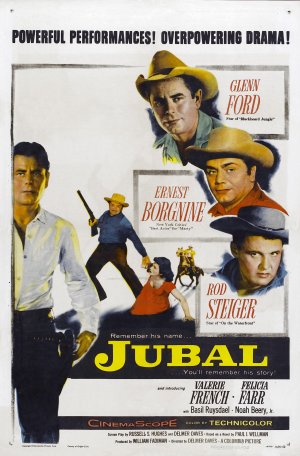
Classic Movie Review: Jubal

Jubal (1956)
Directed by: Delmer Daves.
Written by: Russell S. Hughes & Delmer Daves based on the novel by Paul Wellman.
Starring: Glenn Ford (Jubal Troop), Ernest Borgnine (Shep Horgan), Rod Steiger ('Pinky' Pinkum), Valerie French (Mae Horgan), Felicia Farr (Naomi Hoktor), Basil Ruysdael (Shem Hoktor), Noah Beery Jr. (Sam, Horgan Rider), Charles Bronson (Reb Haislipp), John Dierkes (Carson, Horgan Rider), Jack Elam (McCoy, Bar 8 Rider), Robert Burton (Doctor Grant).


Not long ago I reviewed the 1954 Western Broken Lance as part of this series, and said it owed a great deal to Shakespeare’s King Lear. Now, I come to Delmer Daves’ 1956 film Jubal – which owes a lot to Shakespeare’s Othello. Themes of sexual jealousy are nothing new, but it certainly was for the Western genre back in the 1950s. This is usually the genre of good guys, and bad guys, savage Indians, and the men who won the West. Jubal is more intimate Western than that – basically a four character drama, with some background characters thrown in for good measure. It is a fascinating Western, if not quite a great one. My biggest wish is that they put the Othello character at the center of the movie, and made him more complex. Instead, the title character of Jubal isn’t the Othello character at all – he’s Cassio.

Jubal Troop (Glenn Ford) is crossing the mountain, and nearly freezes to death when he is discovered by Shep Horgan (Ernest Borgnine) – a local cattle baron. He takes Jubal in, feeds him, clothes him and offers him a chance at a job. When Jubal proves himself better than anyone else Shep has, he even makes Jubal the foreman. This doesn’t sit well with Pinky (Rod Steiger), who is used to being top dog. What sits even worse with Pinky is that the bosses’ wife Mae (Valerie French) is making eyes at Jubal – eyes she used to make at him. The good hearted, naïve Shep doesn’t know what type of woman he is married to – but Pinky is there to start planting the seed of doubt in his mind about his wife and Jubal – even though Jubal has rejected all of her advances, and when they were offered to him, Pinky did not.

The performances are the real reason to see the movie – they help to add complexity to roles that could have been rather one note. I’ve always found Glenn Ford to be a rather underrated actor – perhaps because he is always so understated in his performances. As Jubal, he plays a simple man, who wants to be left alone and go about his job. He likes Shep – and feels loyal to him, too loyal to simply get up and leave which is probably the smartest thing he could have done. Ernest Borgnine is the most sympathetic character – a big, naïve, lovable lunkhead, who cannot see what is plain to everyone else around him. I do wish he was given slightly more complexity – and that he didn’t go from trusting to murderously angry quite so quickly – but this is the type of role Borgnine was born to play, and he does so well. Rod Steiger makes a good Iago – his is easily the best performance in the movie (it is, after all the best role), as he spews his poison at anyone who will listen. The movie even finds some sympathy for Valerie French and her performance as Mae – who unlike Desdamona – really has betrayed her husband, and wants to continue to betray him. But she was a small town Canadian girl, who didn’t quite know what she was getting herself into – no matter what you think of her, she deserves a better fate than she gets here. A strange subplot involving religious group really isn’t necessary – although it does give Charles Bronson a fine, early role.

Personally, I would have like to see a little more complexity in the movie. The late, great Roger Ebert referred to Martin Scorsese’s Raging Bull as a modern version of Othello – and he has right. That film addressed the same issues of jealously, violence, sexuality and rage as Shakespeare’s play, and although the language is course and vulgar, it has a poetry to it. In Jubal, everything is a little too straight forward. Not wanting, I guess, to have a conflicted character at its core, it makes the Othello character a supporting player – and puts the undeniably virtuous Jubal at its core.

This isn’t to say that Jubal is a bad movie – far from it. Issues like the sexuality on display in Jubal weren’t really addressed that often in 1950s movie – certainly not in a genre like the Western. It’s also somewhat unfair to expect the film to be as good as Shakespeare’s play – or as good as Scorsese’s movie for that matter.

Jubal has largely been forgotten, so it’s good that the Criertion Collection recently brought out a DVD edition of the film. While it’s not as complex as I would like, it’s certainly more complex than most Westerns of its time.